Do 70% of change initiatives really fail?
Published by Corso & Alexander · About David Luria
Seventy percent of change initiatives do not fail, or at least nobody has ever shown that they do. The figure has no empirical source. It began as an admitted guess in a 1993 business book, was repeated without a citation in a 2000 Harvard Business Review article, and has been copied from one consultant's slide to the next ever since. A 2011 review in the Journal of Change Management traced five published instances of the claim and found valid evidence behind none of them. Surveys of executives do report low success rates for large transformations, roughly a quarter to a third calling them successful, but those are opinions about ambitious programs, not a measured failure rate for change in general. The honest position is that change is hard, the odds are worse than the people launching it usually admit, and the round number everyone quotes is folklore.

That matters for a practical reason. A manager who believes seven in ten efforts are doomed either stops trying or reaches for whatever framework promises to beat the curse. Both responses are bought with a statistic that was never true, and both are worse than the plain work of finding out why change fails in your own building.
Where does the 70% figure come from?
From a sentence its own authors labeled unscientific. In Reengineering the Corporation, published in 1993, Michael Hammer and James Champy wrote that their "unscientific estimate" was that as many as 50 to 70 percent of the organizations attempting reengineering did not achieve the dramatic results they intended. The caveat was in the sentence. The number outlived it.
John Kotter's 1995 Harvard Business Review article Leading Change: Why Transformation Efforts Fail is often cited as the source, but Kotter gave no percentage. Having watched more than a hundred companies attempt major change, he wrote that "a few of those efforts have been very successful. A few have been utter failures. Most fall somewhere in between, with a distinct tilt toward the lower end of the scale." That is an observation from experience, and an honest one. It is not a failure rate.
The number in its modern form arrives in 2000. Michael Beer and Nitin Nohria opened Cracking the Code of Change, also in Harvard Business Review, with the line: "The brutal fact is that about 70% of all change initiatives fail." No citation followed. The sentence was quotable, the magazine was authoritative, and a guess became a fact by being stated flatly in the right place.
Kotter himself later put a number on it. His 2008 book A Sense of Urgency said that more than 70 percent of needed change either fails to launch, is launched but never finished, or finishes over budget, late or with poor results. Read closely, that definition counts a project delivered late as a failure alongside one that never happened. Under a definition that wide, most human undertakings fail.
Is there any evidence for a 70% failure rate?
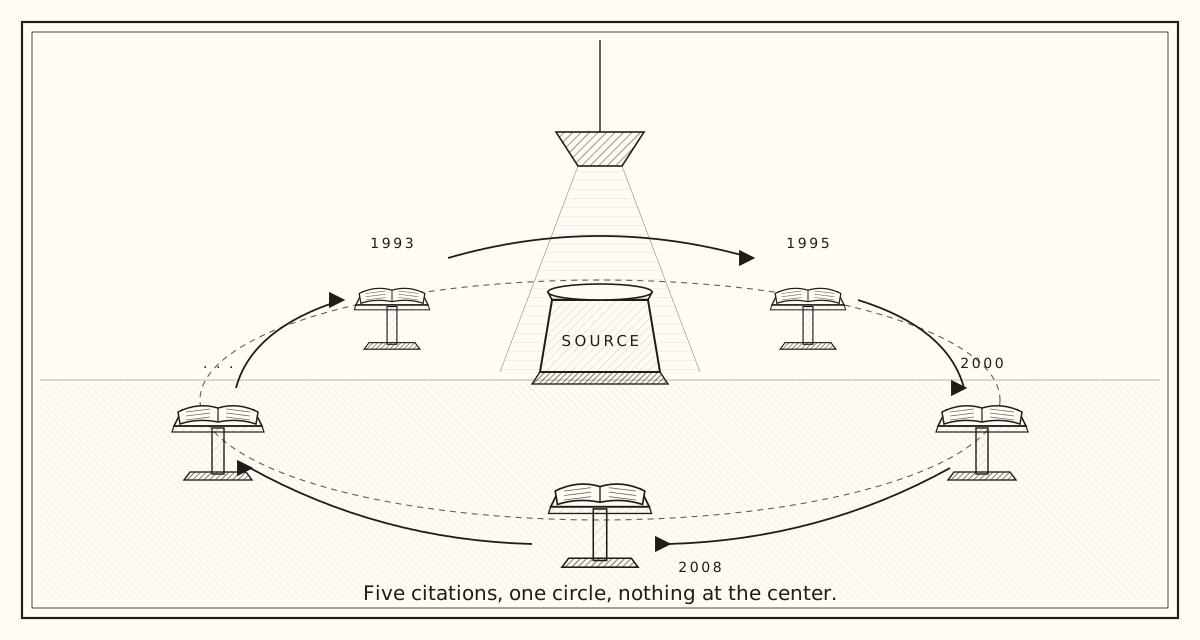
No. That is not a rhetorical flourish; it is the finding of the one serious attempt to check. In 2011, Mark Hughes of Brighton Business School published Do 70 Per Cent of All Organizational Change Initiatives Really Fail? in the Journal of Change Management. He reviewed five separate published instances of the 70 percent claim and, in his words, highlighted "the absence of valid and reliable empirical evidence in support of the espoused 70 per cent failure rate." Each instance either offered no evidence or cited another instance that offered none. The citations pointed at each other in a circle with nothing at the center.
Hughes went further than debunking the number. He argued that the idea of an inherent failure rate for organizational change is itself doubtful. Success in a change effort depends on who is asked, when they are asked, and what they were promised. A cost-cutting program that hits its target and hollows out the sales team is a success to the finance director and a failure to the customer. A merger that looks a disaster at eighteen months can look inspired at five years. There is no single scoreboard, and where there is no scoreboard, a precise failure rate is a category error.
None of that means change succeeds most of the time. It means the question "what percentage fails" has no answer, and anyone giving you one to two significant figures is not reading from data.
What do the surveys actually show?
That executives rate most large transformations as falling short, by their own definitions, with success in the range of a quarter to a third. That is a real finding, worth taking seriously, and it is not the same thing as the folklore.
McKinsey has asked the question repeatedly. Its 2015 survey found just 26 percent of respondents saying the transformations they knew best had been very or completely successful. Its December 2021 research, Losing from Day One, drawn from 1,034 participants surveyed between May and June of that year, all of whom had been through a transformation within five years, found that less than one-third said their companies' transformations had succeeded at both improving performance and sustaining the improvement. The same study estimated that even the transformations rated successful captured only about 67 percent of the financial benefit they had aimed at, while unsuccessful ones captured 37 percent.
Three cautions apply. First, these are self-reported judgments by people with a stake in the answer, not audited outcomes. Second, a "transformation" in a McKinsey survey means a large, multi-year, enterprise-wide program; the sample does not include the thousands of smaller changes that happen quietly and work. Third, the survey's own definition of success is demanding: improve performance and sustain it. Under a looser definition the numbers would move. So the surveys say something real and narrow: big programs, judged by the people who ran them, usually deliver less than they promised. They do not say seven in ten changes fail.
The most useful thing in the 2021 study is not the headline rate but where the value goes missing. McKinsey found that nearly a quarter of the value loss happened during target-setting, before anyone had done anything, and that about 55 percent was lost during and after implementation. The lesson is that a transformation does not usually fail in one place. It leaks from the first meeting to the last, and most of the leak is invisible to a status report.
Why do change initiatives fail, then?
For ordinary and specific reasons, none of which need a statistic to be believed. The pattern across the surveys, the case histories and the practitioners' own accounts is consistent enough that it can be stated without a percentage in front of it.
The target is wrong before the work starts. McKinsey's finding that a quarter of value is lost at target-setting matches what any operator has seen: an aspiration set by benchmark or by boardroom rather than by an honest count of what the organization can actually change, and a plan then built to reach a number nobody believed. A target that is too low leaves money on the table; a target that is too high is quietly abandoned by the people expected to hit it, and everyone spends a year pretending otherwise.
The sponsor is a name, not a person. Every framework in the field, from Kotter's guiding coalition to Prosci's insistence on active and visible sponsorship, says the same thing in different words: change without a senior person who will spend their own credibility on it does not fail loudly. It fades. Decisions queue up, the team fills the silence with guesses, and the effort stops being anyone's priority. This is the same failure that sinks technology projects, and the reasons are set out at length in an earlier note on why so many IT projects fail.
Activity is measured instead of outcomes. A transformation office reports workstreams launched, workshops held and milestones passed. All of it can be green while the thing the program was funded to move has not moved. By the time someone checks the outcome, the money is spent and the sponsor has been promoted.
The people asked to change are treated as an obstacle. What managers call resistance is very often grief for competence, status and a way of working that was about to be taken away, and it responds to being heard rather than being pushed. The note on leading people through a change they did not choose covers this in detail, drawing on William Bridges' distinction between the change, which is announced in a morning, and the transition, which takes as long as it takes.
The effort is abandoned in the dip. New ways of working make people slower before they make them faster, and the low point arrives a few months in, exactly when a nervous leader is looking for a reason to stop. David Luria's Flatten the AI J-Curve names this stretch the kill zone, and the same shape appears in every kind of change, not only technology: output falls, patience runs out, and the program is cancelled at the one moment it was always going to look worst.
Why does the number survive if it is not true?
Because it is useful to everyone who repeats it. A round, frightening figure sells consulting, sells frameworks, sells books and sells conference tickets, and it does so precisely because it makes change sound like a disease with a cure. A manager told that 70 percent of efforts fail and that a particular eight-step method beats the odds has been given a problem and a product in one sentence.
It also flatters the people quoting it. If most change fails, then a leader whose program stalled is in good company, and a consultant whose engagement disappointed was up against the base rate. The number absolves as much as it warns.
And it is unfalsifiable in ordinary use. Nobody who says "70 percent of change fails" defines change, defines failure or names a population, so no result can contradict them. The Hughes review did the only thing that could be done, which was to follow the citations back to their source and report that the source was a guess. Fifteen years later the guess is still on the slides.
There is a familiar shape here. The IT world has its own famous number, the Standish Group's claim that only 16 percent of software projects succeeded, and its own patient researchers who tested the methodology and found it wanting. Fields that deal in uncertainty seem to generate a scary statistic early, then spend decades unable to shake it, because the statistic does a job that the truth, which is messier, cannot.
Does change management work?
Sometimes, and the evidence that it does is better than the evidence that change usually fails, though it comes with the same caveats about who is measuring. McKinsey's surveys consistently find that transformations rated successful share identifiable practices: clear targets tied to the business case, senior ownership, engagement of line managers and frontline staff rather than only the top team, and a deliberate effort to sustain the change after the program office is disbanded. Its 2017 research reported success rates of 26 to 28 percent when line managers and frontline employees were engaged, against 3 percent when either group was left out. Prosci's Best Practices in Change Management study, drawn from more than 2,600 practitioners, reports that 88 percent of projects with what respondents rated excellent change management met or exceeded their objectives, against 13 percent of those with poor change management, a gap Prosci summarizes as roughly seven times.
The caution is that these findings are correlations reported by the organizations selling the practices, and that "the successful ones did these things" is not proof that doing these things makes you successful. Well-run companies both manage change carefully and succeed at it, for reasons that may sit upstream of both. What the evidence supports is the modest claim: the practices associated with success are the unglamorous ones, and no framework substitutes for a real owner, an honest target and the patience to sit through the dip.
What the evidence does not support is the idea that a method beats a base rate, because there is no base rate to beat. The right response to "70 percent of change fails" is not a better framework. It is to stop quoting the number and start asking what, in this organization, on this program, is actually likely to go wrong.
How to tell whether your own change is failing
By writing down, before you start, what success will look like and when you will check, and then checking. This sounds too simple to be advice, and it is the step almost every failed program skipped.
Set the target from an honest count of what can change, not from a benchmark or an aspiration, and record who set it and why. Name the owner, and if no senior person will put their name on the outcome, treat that as the first finding rather than a formality to be sorted out later. Decide which one or two outcomes the program exists to move, and report those, not the activity underneath them, even when the news is bad. Expect the dip, put a date on when you will assess whether the effort is climbing out of it, and hold to that date rather than judging at the low point. And write the prediction down where it cannot be quietly revised, because a program judged against a target that was moved after the fact has told you nothing about whether the next one will work.
Do that and you will have something the 70 percent figure has never had: a definition of failure, a population of one, and a result you can trust. Most organizations never get as far as a number they earned. They borrow one that nobody did.
One email when a book ships. Nothing between.
One email when a book ships. Nothing between. Unsubscribe any time; never sold or shared.