What is the Great Synchronization – and why make time for it?
Published by Corso & Alexander · About David Luria
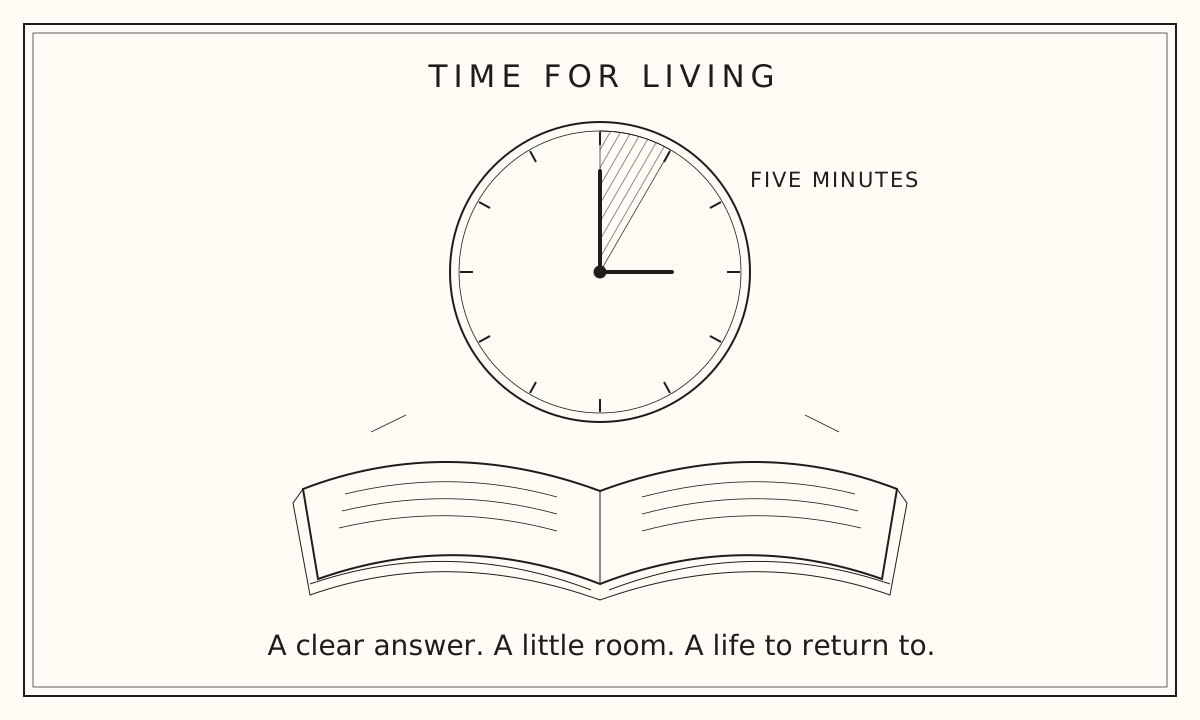
The Great Synchronization is an invitation to pause for five minutes with people around the world, with peace as the shared intention. The organisers have set the moment for Monday, 21 September 2026, at 2pm Central Daylight Time – 3pm Eastern Daylight Time, or 19:00 UTC. You can take part wherever you are, without attending a venue or following a prescribed practice. At Corso & Alexander, the invitation speaks to our mission: giving people time back for the life they want to live. The event website and its local-time chart have the details.
There is a familiar bargain in a busy life. Finish this piece of work, clear that pile, find the answer to one more question, and then there will be time. Time for a friend. Time to walk. Time to sit beside someone without checking what needs doing next.
The bargain is easy to renew. There is always another piece of work.
A date in the calendar puts a small limit on it. Five minutes have an appointed use. For that interval, the next task can wait. This is what draws us to the Great Synchronization: a simple occasion to give attention to something we say matters, while the rest of the day is still making its demands.
What happens during the Great Synchronization?
The organisers name four intentions: peace, love, unity and respect. Participants can sit quietly, pray, meditate or choose another quiet way to mark the moment. The site says no particular belief is required and that you do not need to be on the website during the pause. Its account of the project places the shared moment within a wider invitation to practise those intentions in ordinary life.
That leaves room for people to take the same invitation differently. A person who prays and a person who does not can each find a way to participate. Nobody needs to offer a theory of the universe before sitting quietly for a few minutes.
Our interest is in that modest act. A shared pause gives people an occasion to choose their attention. Any larger claim about its effects would need its own evidence. The invitation can stand on its own without a promise that five minutes will settle a conflict, repair a relationship or change the course of an afternoon.
You may find it moving. You may find that you spend most of it thinking about lunch, an unfinished message or the thing you forgot to buy. There is no need to turn either experience into a verdict on yourself. The time has still been set aside deliberately. What you make of it remains yours.
Why does this belong on a firm's blog?
Our mission is to give people time back for the life they want to live. Useful information is one way we try to do that. A clear answer can shorten a search. A practical guide can help someone avoid a false start. A well-made book can put an unfamiliar situation into words and make the next decision easier to see.
The purpose reaches beyond the moment an answer is found. Someone who spends less of an evening untangling a problem has more of that evening to choose from. They might spend it with family, speak to a friend, exercise or take a few quiet minutes. Those are among the reasons we think this work is worth doing.
The Great Synchronization gives one of those reasons a place on the calendar. It is an invitation to use a small piece of time for presence. For a firm whose mission includes mindfulness and connection, that is a direct fit.
It also asks something of the firm. If we praise reclaimed time in public, our work should respect it in practice. An article should put the answer where the reader can find it. A guide should explain its terms. A recommendation should say what it is based on. We should be willing to let someone find what they need and leave.
That last point matters for a publisher. A reader's attention is something we ask to borrow. We ought to have a good reason for asking, and we ought to know when we have finished.
This note puts the event details in the opening paragraph for that reason. Anyone who came only for the time and the link already has both. The rest explains why the invitation belongs here.
How does making time differ from filling it?
Consider an ordinary evening. Someone has spent an hour searching for an answer about a parent's affairs. There are several tabs open. Each seems to require another. A friend has called, a meal has gone cold and the person they are trying to help is sitting in the next room.
This is an illustration, not a report about a particular family. It describes the kind of trade we keep in mind when we decide whether information is useful. The cost of a confusing explanation is paid somewhere. It may be paid in another search, another call or an evening that ends before the conversation begins.
A good answer can bring that search to a stopping point. But the stopping point deserves attention too. There is a choice between opening another tab and going into the next room. The value of the information becomes clearer when we look at what it makes possible afterwards.
The same question applies to tools for work. A shorter task can leave room for a thoughtful conversation with a colleague. It can also lead straight to another task, followed by another, until the working day is as long as it was before. The person doing the work needs some say in where the saved time goes.
We cannot choose that use for our readers. The promise of reclaimed time includes their freedom to spend it differently from us. Someone may want a longer walk. Someone else may want an uninterrupted hour with a difficult book. Someone may want to sit in silence, with no useful result to show anyone.
A pause for peace is one possible use. We are sharing it because it brings the question of use into view: there is a life to be lived with the hours we work so hard to recover.
What do curiosity, ideas and kindness have to do with it?
Curiosity, ideas and kindness are the values we want to bring to our work. Each has a practical bearing on this invitation.
Curiosity means looking closely at what is being proposed. Here, the immediate proposal is a shared pause at a stated time. We can understand that act, consider its appeal and keep our judgment about claims beyond it. Taking an idea seriously includes being precise about its limits.
Ideas need a route into life. An intention such as being more present can remain vague for a long time. A specific time and a small action make it possible to try. The event interests us partly as an example of that passage from an appealing thought to something a person can actually do.
Kindness gives the pause a direction. It can mean leaving a little room before replying, listening to the end of a sentence or remembering that another person's day contains things we cannot see. These are choices, not guaranteed results of participation. They are also close enough to ordinary life to be put into practice without waiting for a larger change.
For a firm, kindness includes how we treat a reader who is tired, worried or short of time. We can make the explanation clearer. We can avoid making someone feel foolish for needing it. We can say when the information does not answer their question.
There is no need to make kindness sentimental. Sometimes the useful thing is a correction, a limit or an honest account of uncertainty. Care shows in the way it is delivered and in whether it leaves the person better able to act.
These values make the event relevant to our work. They also give us a way to examine our own endorsement: understand the invitation, explain the action and leave room for the reader's choice.
How can a busy person make room for five minutes?
Begin with the actual day you have. If the shared time is free, a reminder may be all the preparation you need. Choose somewhere you can stop comfortably, with as little ceremony as you want. A chair by a window is enough.
If you are with someone, you could invite them to join you. Make it easy for them to decline. A shared intention loses something if another person has to accept it to keep the peace. Five quiet minutes together should leave both people room to be themselves.
For a caregiver, the day may refuse to cooperate. A parent may need help at the appointed moment. For someone at work, a task may not be safe to interrupt. For someone travelling, the time may fall in the middle of a journey. Attend to what needs you. The invitation should not become another demand against which a crowded life is judged.
You can choose another moment for your own pause. That will be separate from the synchronised event, and it can still serve the purpose you had in mind. A calendar is useful when it helps us act on our priorities. It is less useful when it becomes a list of ways we have fallen short.
There is also no need to make a performance of the interval. You need not record it, describe it online or find the right words afterwards. You can return to your day without producing anything. The permission to do that is part of the appeal.
If you want to carry the intention forward, choose one small act that fits the next part of your day. Give someone a full hearing. Send a kind message you have been putting off. Finish a conversation before reaching for your phone. These are suggestions from us, not conditions of taking part.
What would make the pause worthwhile afterwards?
We would look close to home. Perhaps it prompts a conversation about where the week has gone. Perhaps it makes room for a person whose company has become something squeezed between errands. Perhaps nothing noticeable happens, and the five minutes remain simply five minutes spent as you chose.
There is value in keeping the scale honest. It lets an ordinary act remain ordinary. It also leaves us free to ask for evidence when someone makes a larger claim. Good intentions and good judgment belong in the same room.
For Corso & Alexander, the useful follow-through is to keep applying the mission to our own work. We can ask whether a page helps someone reach an answer. We can ask whether a book earns the hours it takes to read. We can ask whether a tool gives its user more control over their time, and listen when the answer is no.
Those questions are harder than putting a sentence on a mission page. They require choices about what to publish, what to cut and what to explain more clearly. They require us to notice when our work adds to the burden it was meant to ease.
The pause offers a small occasion to remember the people at the far end of those choices. A reader has a household, a body, friendships, worries and things they hope to do before the day is over. Our books occupy only a part of that life. We want that part to help the rest.
This is why the event belongs beside our work as a firm. It makes room for a purpose that can disappear behind the effort to get things done: having enough attention left to inhabit the life around us.
How do I take part on 21 September?
Use the organisers' time chart to confirm the time where you are. In the eastern United States, the shared pause begins at 3pm EDT on Monday, 21 September 2026. In the central United States, it is 2pm CDT. The same instant is 19:00 UTC.
The Great Synchronization website explains participation. If the moment fits your day, set it aside. If it does not, you can still make room for the people and intentions that brought you to the idea.
Our mission is to help people recover time for the life they want to live. Five minutes spent deliberately, with room for others in mind, is one small expression of that life.
The next task will still be there.
One email when a book ships. Nothing between. Unsubscribe any time; never sold or shared.