Does change management mean layoffs — and does restructuring always mean layoffs?
Published by Corso & Alexander · About David Luria
Change management does not mean layoffs, but layoffs are almost always announced in its vocabulary, which is why the two have been confused for thirty years. The discipline itself is older and narrower than the fear suggests: it is the set of methods for getting people to work in a new way once a decision has been made, and most of the changes it is applied to, from a new software system to a merger of two departments, leave the headcount alone. The confusion comes from the other direction. When a company does intend to cut jobs, it reaches for the same words, restructuring, transformation, realignment, because they are true in a narrow sense and gentler than the plain one. So the honest answer to an employee asking the question is this: the phrase on its own tells you nothing, the announcement around it tells you a great deal, and there is a short list of things to look at that will tell you which kind of change you are in.

What is considered change management?
Change management is the management of the people side of a change that has already been decided: explaining why it is happening, preparing people to do their jobs differently, training them, dealing with the resistance any imposed change produces, and keeping the new way of working in place after the consultants have left. Prosci, the firm whose ADKAR model is the most widely used in American companies, defines it as the discipline that guides how people are prepared, equipped and supported to adopt a change. John Kotter's eight steps, published in the Harvard Business Review in 1995, are a change-management model. William Bridges' transition work is another. None of these models is about deciding who stays. They begin after that decision, whatever it was.
The discipline grew out of Kurt Lewin's work on group behavior in the 1940s and was shaped by the large systems projects of the 1980s and 1990s, when companies learned that installing software was the easy part and getting four thousand people to use it was the hard part. The failure rate of those projects, covered in an earlier post on why so many IT projects fail, was the commercial reason the field exists.
So when a project has a change-management workstream, that is almost always what is meant: communication, training, adoption. It is not a code word. In its ordinary use, the phrase describes some of the least threatening work in the building.
Does restructuring always mean layoffs?
Restructuring does not always mean layoffs, but it means them often enough that the word has lost its innocence. In its strict sense, a restructuring changes the shape of an organization: which units report to whom, how work is divided, where decisions are made. A company can restructure by merging two regions into one, by moving a function from the divisions to the center, or by splitting a product group in two. Each of these changes jobs without necessarily ending any. Kim Cameron, who studied downsizing at the University of Michigan through the early 1990s, drew the distinction in a 1994 paper in Human Resource Management by naming three strategies that organizations use when they want to get smaller or cheaper: workforce reduction, which is layoffs, early retirements and attrition; work redesign, which removes functions, layers and tasks; and systemic change, which alters the culture and the way work is done over a longer period. Only the first is a layoff. The second and third are what the word restructuring was coined to describe.
The trouble is that the first strategy is the fastest and the easiest to measure, so companies that announce the second or third frequently end up doing the first; Cameron found that most organizations he studied relied on workforce reduction because it was the only one of the three that showed on a spreadsheet within a quarter. A redesign that removes a layer of management is a restructuring in the strict sense. The managers in that layer still lose their jobs.
The clearest case of the words parting from their meaning is reengineering. Michael Hammer and James Champy's Reengineering the Corporation, published in 1993, was about redesigning processes from a blank sheet, not about cutting staff. Within two years the word had become the standard American euphemism for a layoff. Thomas Davenport, who had written one of the first papers on process redesign, wrote in Fast Company in 1995 that once out of the bottle the reengineering genie quickly turned ugly. Hammer himself, interviewed by Joseph White in the Wall Street Journal in November 1996, said he had not been smart enough about the human dimension, that he had been reflecting his engineering background, and that he had learned it was critical. The method was sound. What people learned to hear in the word was the thing done in its name.
Layoff vs restructuring: how to tell which one you are in
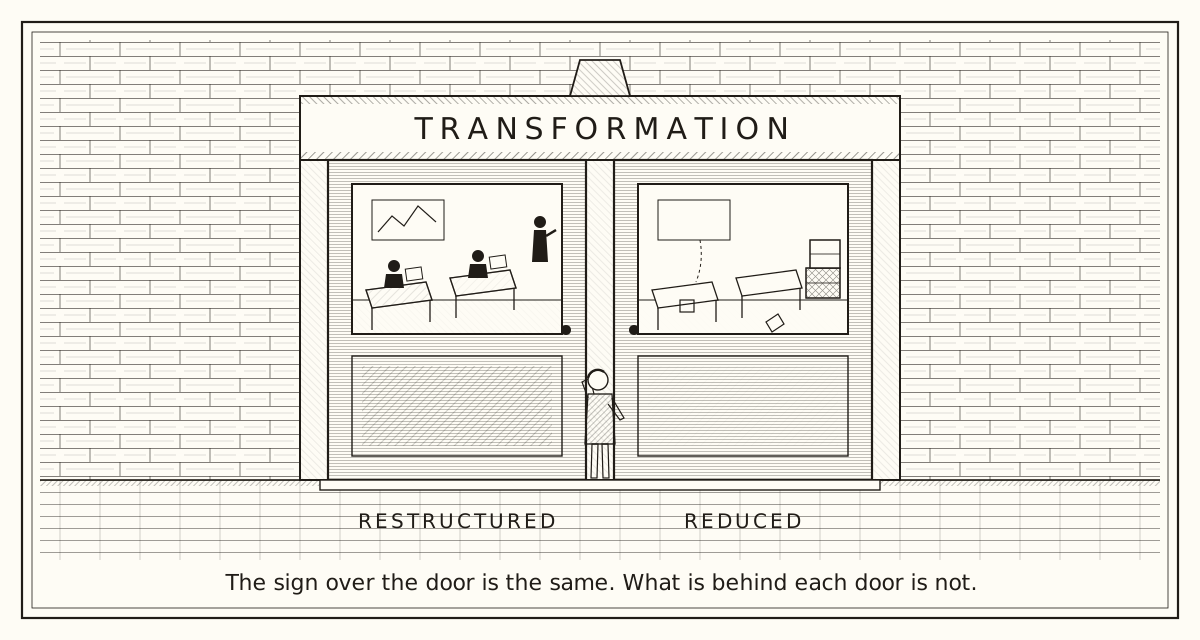
The difference between a layoff and a restructuring is visible in four places, and none of them is the announcement's vocabulary. The first is the number. A layoff has a headcount target, a percentage or a dollar figure for savings, and that number was set before the design work began. A genuine restructuring has an organizational design, and the headcount is whatever that design turns out to need. If leadership can tell you how much will be saved but not yet how the work will be arranged, the number came first, and a number that comes first is a layoff looking for a shape.
The second is the order of events. In a restructuring, the new structure is published, roles are defined, and people are mapped onto them; some roles are eliminated and the people in them are told. In a layoff dressed as a restructuring, the people are told first and the structure is drawn afterward around whoever is left. If managers are asked to rank their teams before anyone has seen an org chart, the ranking is the real project.
The third is who leads it. A restructuring is led by the operating executives whose organization is changing, with HR in support. A cost program is led by finance, with the operating executives as recipients. When the chief financial officer is presenting the change, the word on the slide matters less than the name on it.
The fourth is the law, which has no interest in the vocabulary. The federal Worker Adjustment and Retraining Notification Act requires employers with a hundred or more full-time employees to give sixty days' written notice of a plant closing or a mass layoff, which the statute defines by the number of people affected at a site, not by what the company calls it; several states, New York, California and New Jersey among them, have versions with lower thresholds. If notices go out under WARN, the change is a layoff under federal law, whatever the deck says.
What are the signs of layoffs coming?
The signs of a coming layoff are financial, procedural and verbal, in that order of reliability. The financial signs come first and are the hardest to disguise. A hiring freeze, especially one that cancels offers already made, means the company has decided headcount is going down and is letting attrition start the work. Cuts to travel, training and contractors follow. A missed quarter, a profit warning, or a new chief executive with a mandate for efficiency are the external versions of the same signal. None guarantees a layoff. Together they describe a company that has started to count.
The procedural signs are the ones employees notice and discount. Managers are asked to document performance more carefully, or to produce rankings. A reorganization is announced with the structure to follow. An outside firm appears in meeting rooms. Each has an innocent explanation, and each is also a step in the sequence that precedes a reduction, because a company cannot cut jobs without first deciding which ones, and deciding which ones requires exactly this paperwork.
The verbal signs are the least reliable and the most discussed. A shift in the language of all-hands meetings toward efficiency, focus and doing more with less is a real signal but a weak one, because executives use that language in good years too. The more useful sign is a change in what is not said. When leaders answer direct questions about headcount with a formula about no plans at this time, the formula is chosen because it is true today and will not be quoted against them next month. Silence and formula are what people give when they know and cannot say.
An earlier post on why people resist change even when it is positive argued that resistance is a response to specific, countable losses. A workforce that has read these signs is not resisting change. It is responding to a loss it has correctly predicted and not been told about, and the resentment after a layoff everyone saw coming is aimed at the pretense as much as at the cut.
Do layoffs actually save money?
Layoffs save less money than their announcements claim, and the best long-run evidence finds no reliable financial benefit at all. Wayne Cascio, at the University of Colorado, has studied this longer than anyone. In a 2002 paper in the Academy of Management Executive, he reported on 6,418 employment-change events at Standard & Poor's 500 companies between 1982 and 2000, sorting firms into groups by whether they had cut or added employees and whether they had cut or added assets, and following their results for two years afterward. He found, in his words, no significant, consistent evidence that employment downsizing led to improved financial performance, measured as return on assets or industry-adjusted return on assets. The group that did best was not the companies that cut people. It was the companies that grew their assets; by the end of the second year their returns were 41 percent higher than those of the employment downsizers.
The reasons are mechanical rather than moral. Severance and legal costs are paid at once against savings that arrive over time. The work does not leave with the people; it is redistributed to those who remain, or contracted back six months later at a higher rate. Knowledge of customers, systems and exceptions goes out the door and is paid for again in errors. And the survivors leave. Charlie Trevor and Anthony Nyberg, in a 2008 paper in the Academy of Management Journal, studied 267 company-years of data from firms applying to the Fortune 100 Best Companies list and found that even small cuts raised voluntary turnover sharply: downsizing half of one percent of the workforce predicted a 25 percent rise in the rate of people quitting, and cutting two percent predicted a 36 percent rise. The people who leave voluntarily after a layoff are disproportionately the ones with options, which is to say the ones the company most wanted to keep.
Deepak Datta and colleagues reviewed the whole body of downsizing research in the Journal of Management in 2010 and found patterns and contradictions rather than a dependable payoff, with the firm-level results more often disappointing than not. This does not mean layoffs are never necessary. A company that has lost a third of its revenue cannot carry the cost base built for all of it, and Cascio's own distinction is between downsizing as a reflex, in which employees are costs to be cut, and what he calls responsible restructuring, in which they are assets to be redeployed and the cut is the last tool rather than the first. The point for an employee reading an announcement is narrower. A layoff justified as efficiency is a bet with a poor track record, and the people proposing it usually know that, which is one more reason to call it something else.
Do layoffs increase the stock price?
Layoffs do not reliably increase the stock price, and the earliest research found they lowered it. Dan Worrell, Wallace Davidson and Varinder Sharma, in a 1991 paper in the Academy of Management Journal, examined the stock-market reaction to layoff announcements by large American companies and found that on average the market reacted negatively, particularly when the layoff was presented as a response to financial trouble rather than as part of a strategic reorganization. Henry Farber and Kevin Hallock, following the question through 1999 in a paper later published in Labour Economics, found that the average reaction had become less negative over the decades, as layoffs shifted from a sign of distress to a routine of management. It never became reliably positive.
The belief that it does rests on a handful of cases where a stock rose on the day, usually because the announcement accompanied a strategy the market liked. The folk wisdom is strong enough that executives act on it, which is part of why employees hear the word restructuring and assume the worst. The evidence says the reward is small, uncertain and short. The cost is certain, and it falls on the people who were not cut.
What is layoff survivor syndrome — and what should you do after surviving a layoff?
Layoff survivor syndrome is the pattern of guilt, anxiety, anger and reduced commitment found among employees who keep their jobs when colleagues lose theirs. David Noer named it layoff survivor sickness in his 1993 book Healing the Wounds, after following a large company through repeated rounds of cuts, and described survivors who were fearful, cynical about management and working harder while caring less. Joel Brockner, at Columbia, had been running studies of survivors since the mid-1980s and found that what determined their reaction was less the fact of the layoff than its fairness: whether the people cut were treated decently, whether the criteria were explained, whether the survivors believed the same could be done to them without warning. Where the process was seen as fair, commitment held. Where it was seen as arbitrary, it collapsed, and the collapse was in the people the company had chosen to keep.
This is where change management, in its honest sense, re-enters. A layoff is a change, and the people who remain have to be led through it like any other. The survivor research is a record of what happens when that work is skipped: the badges are collected and everyone is expected back the next morning with a larger workload and a smaller team. The companies that come through intact treat the survivors as the actual subject of the change and give them a reason to stay that is more than relief.
For the employee who has just survived one, the record points in two directions. Find out what the new structure is and where your role sits in it, because a role that was not redesigned after a cut is a role that was overlooked, and overlooked roles are cut next. Then notice whether the work of the departed has been redistributed with a plan or left on the nearest desk; the answer tells you whether the company did a restructuring or a layoff, and therefore whether there will be another.
What does change management mean for employees?
For an employee, change management means that a decision has been made above you and that someone has been assigned to help you live with it. That is less sinister than it sounds and less comforting than its practitioners intend. The decision may be a new system, a new reporting line, a merger or a cut; the discipline is the same in each case, and its presence does not tell you which. What it does tell you is that the organization expects the change to be difficult for people, has budgeted for that difficulty, and has a plan for your part in it. That is a better position than the alternative, which is a change with no one assigned to the people at all.
What the phrase does not mean is that the decision is open. Change management begins after the decision, and the people in the room are there to help with adoption, not to reconsider. The useful questions to ask them are the ones they can answer: what the new structure is, when it takes effect, what training exists, who decides the exceptions, and what the measure of success will be. The gaps in those answers are a better guide to what is coming than any reading of the vocabulary.
There is one more thing the research supports, and it is the reason the question matters beyond the person asking it. David Luria, in Flatten the AI J-Curve, puts it as a rule of organizational life: growth stories get approved and cost-cutting stories get fought. A change announced as capacity, more volume with the same team, new markets, work that was previously impossible, is adopted by the people who have to carry it out. The same change announced as a reduction is slow-walked by the same people, because they have been told what it costs them and not what it gives them. Companies that use the language of change management to hide a cut are buying a few weeks of quiet with the one thing a change cannot succeed without, which is the belief of the people doing the work that they are being told the truth. The answer to the employee's question, then, is also the answer to the company's. Change management does not mean layoffs. Saying it when you mean layoffs is how it comes to.
One email when a book ships. Nothing between.
One email when a book ships. Nothing between. Unsubscribe any time; never sold or shared.