Why do people resist change even if it's positive?
Published by Corso & Alexander · About David Luria
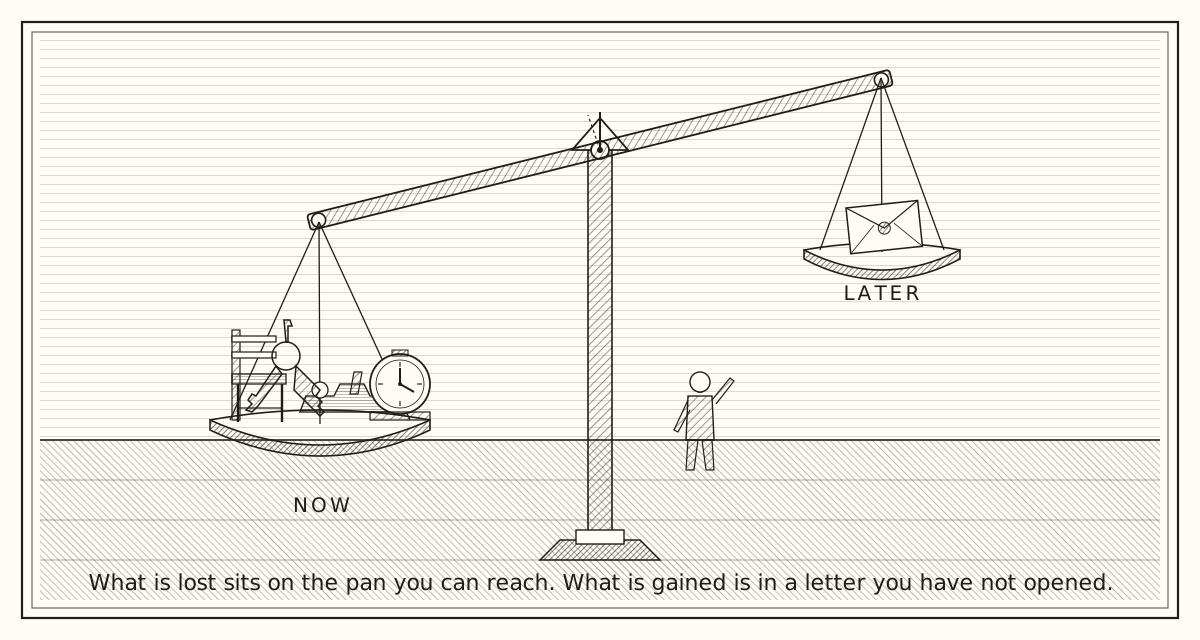
People resist positive change because the losses in any change are specific, immediate and personal, while the gains are general, delayed and forecast by somebody else. A new system, a merger or a better process takes away things a person can name today: competence built over years, a routine that ran without thought, standing among colleagues, control over how the day goes. What it offers in return is a benefit that arrives later, spread across the organization, and promised by the people who chose the change rather than the people living through it. Human judgment weighs a certain loss at roughly twice the value of an equal gain, so a change that is a clear net positive on paper can still read as a net loss to the person asked to make it. Add that the word positive was decided by someone else, and that the first months of any real change make people worse at their jobs before they get better, and the resistance stops looking irrational. It is an accurate response to the terms on offer.
Why do people resist change, psychologically?
Because the mind is not neutral between having and getting. In 1979 Daniel Kahneman and Amos Tversky published prospect theory, the finding that people judge outcomes as gains or losses from a reference point rather than as final states, and that losses loom larger than gains of the same size. Later estimates from Tversky and Kahneman put the ratio at a little over two to one: a loss of a hundred dollars hurts about as much as a gain of two hundred dollars pleases. The reference point for anyone facing a change at work is the job as it is now. Everything the change removes registers as a loss from that point; everything it adds registers as a gain. Weighted at two to one, a change has to be far better than the status quo before it feels like a fair trade.
In 1990 Kahneman, Jack Knetsch and Richard Thaler ran the experiments that established the endowment effect: people given a coffee mug demanded about twice as much to sell it as people without a mug were willing to pay to buy one. Ownership alone raised the value, and a way of working that a person has owned for a decade is owned in the same sense. In 1988 William Samuelson and Richard Zeckhauser, writing in the Journal of Risk and Uncertainty, named the broader pattern status quo bias. In their data on Harvard University employees choosing health plans, new hires picked the newer plans at much higher rates than existing employees switched into them, though the plans were the same. Nothing about the old plan had to be better; it only had to be theirs.
A third mechanism concerns freedom rather than value. In 1966 Jack Brehm described psychological reactance: when a person perceives that a freedom is being removed, they are motivated to restore it, often by doing the forbidden thing harder. A change that is announced rather than offered removes the freedom to keep working the old way. Reactance does not care whether the new way is better. It responds to the removal, which is why the same change meets less resistance offered as a choice than issued as an instruction.
Why do we resist change so much?
Because most of what a change takes away is invisible to the people who designed it. In 1999 Eric Dent and Susan Goldberg published a paper in the Journal of Applied Behavioral Science titled "Challenging 'Resistance to Change'," and their central claim was that people do not resist change as such. They resist the loss of status, the loss of pay, the loss of comfort, and the loss of competence, and the change happens to be the vehicle. They traced the phrase to Kurt Lewin's work in the 1940s, where resistance was a property of the whole system, and noted that by the time it reached management textbooks it had become a personal failing of employees. A systems property is something to analyze. A personal failing is something to overcome.
Competence is the largest of these losses. A person who has been fast and sure at a task for years is, on the first day of the new process, slow and unsure, and is being watched. Shalom Oreg's 2003 work in the Journal of Applied Psychology, which built a scale for individual differences in resistance to change, found four components: a preference for routine, an emotional reaction to imposed change, a short-term focus, and cognitive rigidity. The short-term focus is the one worth underlining. People who score high on it are not denying that the change will pay off. They are weighting the next three months more heavily than the next three years, which is what loss aversion predicts and what a person with a mortgage and a performance review might reasonably do.
Then there is the question of who decided the change was positive. In 1979 John Kotter and Leonard Schlesinger, in the Harvard Business Review article "Choosing Strategies for Change," listed four common reasons people resist: parochial self-interest, misunderstanding and lack of trust, different assessments of the situation, and a low tolerance for change. The third is the one most often skipped. The people closest to the work know things about it that the people redesigning it do not. When they say the new system will not handle the exceptions, they are sometimes right, and a program that files that as resistance rather than information loses its one chance to hear it before launch. Jeffrey Ford, Laurie Ford and Angelo D'Amelio made the same argument in a 2008 Academy of Management Review paper: resistance is frequently a resource, a sign that people are engaged enough to argue, and change agents themselves often create it by breaking earlier agreements and describing the change in ways that turn out not to be true.
Why do people resist change in the workplace?
Because a job is a bundle of agreements, most of them never written down, and a change rewrites them without asking. Paul Strebel put this plainly in a 1996 Harvard Business Review article, "Why Do Employees Resist Change?" Every employee, he argued, holds a personal compact with the organization along three dimensions. The formal dimension is the job description, the pay and the reporting line. The psychological dimension is the unwritten expectation: how hard I work, what recognition I get, whether effort is noticed. The social dimension is what the company says it values, and whether its behavior matches. A change that looks like a process improvement from the top is, from below, a unilateral revision of all three. The pay may be untouched while the psychological compact is torn up, and the person resists as if their pay had been cut, because in the currency that mattered to them it has been.
Robert Kegan and Lisa Lahey explained the cases where people say they want the change and still do not make it. Their 2001 Harvard Business Review article, "The Real Reason People Won't Change," described competing commitments: a manager who sincerely commits to delegating more, and also holds an unspoken commitment to being the person who knows every detail, will not delegate, and will not understand why. Kegan and Lahey called this an immunity to change, on the analogy of an immune system attacking something that would help. They are protecting something the change threatens, and until it is named, no amount of agreement produces movement.
Workplace change also carries a cost its designers rarely count, because it does not land on them: the period of double work. When a new system arrives, the old one does not vanish on the same day. People run both, checking the new against the old, while their normal output is still expected. David Luria's Flatten the AI J-Curve describes this double-keying as the mechanism behind the productivity dip that follows enterprise AI rollouts, with the low point arriving around the fourth month and workload rising by roughly half before it falls. The economists Erik Brynjolfsson, Daniel Rock and Chad Syverson documented the same shape at the level of whole economies in "The Productivity J-Curve," published in 2021: the investment in learning and reorganizing that a new technology requires shows up as a productivity loss before it shows up as a gain, sometimes for years. An employee who resists a change that is positive in the long run is, in the short run, being asked to work harder for less output and to be judged on the output. That is not a perception.
What are some examples of resistance to change?
The best documented is a pajama factory in Marion, Virginia. In 1948 Lester Coch and John French published "Overcoming Resistance to Change" in the journal Human Relations, reporting a field experiment at the Harwood Manufacturing Corporation. Harwood paid its operators by the piece and changed its methods often. Each change was small, a different fold or a new sequence of operations, and each produced the same result: output fell, took weeks to recover if it recovered at all, and was accompanied by grievances about the piece rate, hostility toward supervisors, and people quitting. Experienced operators, moved to a changed job, took longer to relearn it than new hires took to learn it fresh.
Coch and French set up a comparison. One group was told about a change in the usual way: called together, informed, given the new rate and sent back to work. A second group was told why the change was needed, shown the competitive pressure behind it, and asked to choose representatives who would help work out the new method and rate. A third set of groups, smaller, was given the same explanation and then took part in designing the new job themselves, every operator, not only representatives.
The no-participation group behaved as Harwood's history predicted. Output dropped sharply and stayed low for the thirty days the group was followed. Grievances were filed about the rate. Within forty days roughly one in six of the group had quit. The representative group recovered its old output in about two weeks. The full-participation groups recovered faster still and then went past their previous rate, settling around fourteen percent above where they had started. Months later, the remaining members of the no-participation group were moved to a new job under the full-participation method. They recovered quickly and exceeded their earlier output: the same people who had resisted the first change, resisting nothing.
The example removes the usual excuses. The change was positive; the company lived on such changes. The workers were not rigid; the same workers behaved differently under different terms. Told, they lost a freedom and a competence and were handed a promise. Consulted, they kept some control, understood the reason, and shaped the method they would have to live in. The losses did not disappear, but they were smaller, and they were chosen.
A modern example runs the same way. An analytics team is given an AI tool that drafts the weekly reports its members used to write by hand. The tool is good; its drafts need editing but save hours. Within a month, use has fallen to two people. Asked, the analysts say the drafts are fine. Asked further, one says the report was the one thing the executives read with her name on it. Another says he no longer knows the numbers the way he did when he assembled them himself, and was caught out in a meeting. The gain was time. The losses were authorship and command of the material, neither in the business case, both present in the first week.
Why do people resist change in organizations?
Because the organization measures the gain and the individual absorbs the loss. The business case is written in the organization's currency: cost, throughput, risk, revenue. The resistance arrives in the individual's: competence, standing, control, hours. The program reports that the change is positive and that people are resisting anyway, which is puzzling only if everyone is keeping the same books.
Three organizational habits make this worse. The first is announcing outcomes and hiding reasons. Distrust grows in the gap between what leaders know and what they say, and people fill the gap with the worst plausible story, then resist that story. The second habit is treating the first months of lower performance as evidence about the change rather than as the expected cost of it. Coch and French's no-participation group, judged on its thirty-day output, would have looked like proof that the change failed; Brynjolfsson's J-curve says the same of entire industries. An organization that reads the dip as failure abandons changes that were working, and its people learn that the safest response to the next change is to wait it out.
The third habit is the most expensive. Organizations break their own earlier agreements in the course of a change, then attribute the distrust to the change. Ford, Ford and D'Amelio catalogued it: the reorganization that was to be the last one, the promise that no roles would go, the pilot presented more favorably than the people in it remember. Since the gains from any change are mostly promises, an organization with that record has discounted its own case, and its people are pricing its forecasts correctly.
How can resistance to change be reduced?
By shrinking the losses, moving the gains closer, and returning some of the control, before the change rather than after the resistance appears.
Name the losses in the organization's own voice. A change program that says "this will be better" and nothing else has left every specific loss for the people affected to discover on their own, at which point it arrives as a betrayal. One that says "you will be slower for three months, the reports will not carry your name, and the exceptions you handle by judgment will need a new home" has converted unknown losses into known ones. Known losses are still losses, but people can plan for them, and the naming tells them that someone counted.
Give people a hand in the method, not only a briefing on the outcome. This is the Harwood result and it has held up in the decades since. Participation shortens recovery because the people doing the work catch problems the designers missed, and because a method one helped shape is one's own, so the endowment effect works for the change instead of against it. At Harwood the representative version worked, the full version worked better, and the instruction version did not work at all.
Protect competence through the dip. The single largest loss in most changes is the loss of being good at one's job, and it is the most fixable. Training scheduled before the change rather than cut after it, protected time to run old and new in parallel, a stated period in which targets are suspended: each turns a private humiliation into an expected phase. Flatten the AI J-Curve argues that the organizations that survive the dip are the ones that budgeted for it before the rollout and put dates on when they would assess, so that the low point was a milestone rather than a surprise.
Move a gain forward. Losses arrive on day one; gains arrive in year two; loss aversion does the rest. A real benefit to the people making the change, inside the first weeks, changes the arithmetic. It need not be large. It must land on the people bearing the cost, not on the budget line.
Ask what people are protecting. Where someone wants the change and does not make it, a competing commitment is usually in play, and the useful question is not "why are you resisting" but "what would you lose if this worked." The answer is often something no one thought to address, and once on the table it usually can be.
Keep the agreements you make on the way. Promises are the currency the gains are paid in, and every one broken devalues the next.
Should resistance to change be expected?
Yes, and the organizations that expect it do better than the ones surprised by it. Resistance is what loss aversion, the endowment effect, reactance and the J-curve produce together when a person is asked to give up something certain for something promised. It appears whether the change is good or bad, because the mechanisms do not read business cases. A program that has planned for no resistance has planned for a population without ordinary human judgment, and will spend on persuasion what it should have spent on the terms.
The hopeful part of the record is that the same people who resist a change under one set of terms accept it under another. The Harwood operators did not become different people between the first experiment and the second. The analysts who stopped using the tool would use a version that kept their names on the work and left them the numbers. What changed was whether anyone had counted what they were being asked to give up, and whether the count was honest. Positive change, it turns out, is not a property of the change. It is a property of the deal, and the deal is the one part of the whole business that the people announcing the change fully control.
Where the change is not positive at all, or people were never asked, the earlier post on leading people through a change they did not choose covers the transition itself. And for the number quoted whenever this subject comes up, the 70 percent failure rate has a shorter history than its reputation suggests.
One email when a book ships. Nothing between.
One email when a book ships. Nothing between. Unsubscribe any time; never sold or shared.