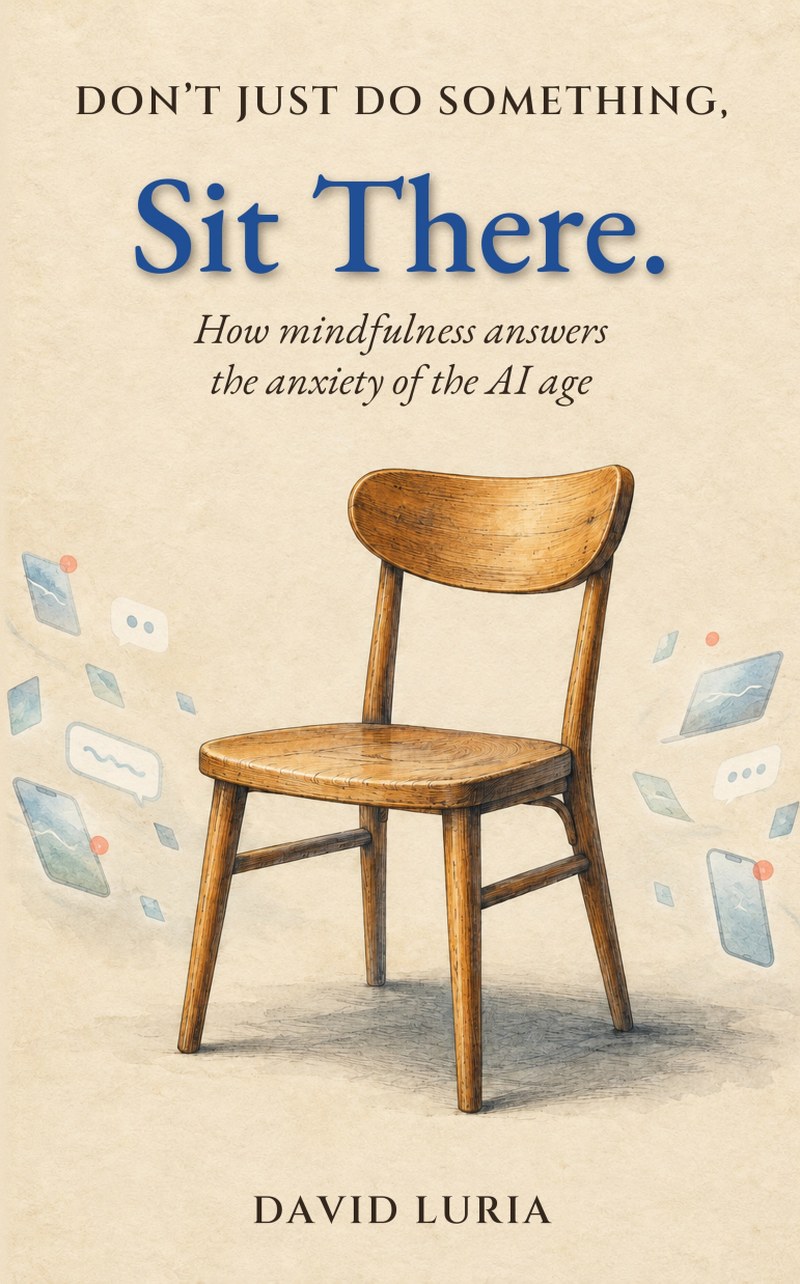
Don’t Just Do Something, Sit There.
How mindfulness answers the anxiety of the AI age
Don’t race it · Sit with it
Tempered Press · Coming soon
How mindfulness answers the anxiety of the AI age
Don’t race it · Sit with it
Twenty years good. And every month the machine does a little more of it.
David Luria likes working with AI. After weeks of building an assistant that would not work, and then suddenly did, he stood up from his desk with chest pains. This is his honest account of what came next.
Six short chapters, built on the yamas, yoga’s five restraints: letting go, truth, the right use of energy, and not harming, beginning with yourself. Along the way: Ada Lovelace and Charles Babbage, a student string quartet that could not learn Mozart any faster, and a pandemic that felt worse and better than it was.
The book does not ask you to fight AI or to keep pace with it. It asks you to sit with what it stirs up: the fear of becoming irrelevant, the worry that you are not smart enough, and the quiet question of who is driving. Each chapter ends with a short practice you can do at your desk, on a walk, or on a park bench.
No email required. This is how Chapter One begins.
From Chapter One · The Open Hand
It was a Thursday. The thing worked.
I had been building it for seven weeks. Seven weeks of promises in meetings — because I wrote the book, because I was the AI guy, because if anyone could make it work, it was supposed to be me. For seven weeks it did not work. There is a kind of not-working where you stop telling people how it is going. I was there.
Then it worked. No fanfare. Output where there had been nothing. Correct, the way it was meant to be.
I stood up from the desk. Something put a knife point in my chest.
It came in waves. Sharp, for about five minutes. I could walk. I could breathe. So I walked. I was halfway down the hall before I knew where I was going — toward the defibrillator on the wall by the elevators. I had not decided to go. An older part of me had decided.
The thought I had, walking toward it, was simple. I hope somebody here knows how to use that thing.
By the time I reached the wall, I was better.
Not a heart attack. I’ll spare you the hours it took to learn that. There is a particular humiliation in lying still while machines confirm that nothing is wrong with you.
Because something was wrong with me. It just wasn’t in my chest.
The chapter closes with a short practice.
Short on purpose. Each one ends with a practice, not a plan.
Real agency was never in the task.
The line the book turns on — and the reply to the question of who is driving.
The fear of becoming irrelevant.
The worry that you are not smart enough.
The quiet question of who is driving.
This book is written by a colleague, not a teacher. Twenty years in, he is still working it out, and he says so.
Coming soon. One email when it ships, and nothing else.
Confirm your address by email, then we'll send a note when a new book ships. Unsubscribe any time. No phone number. Your address is never sold. Privacy.