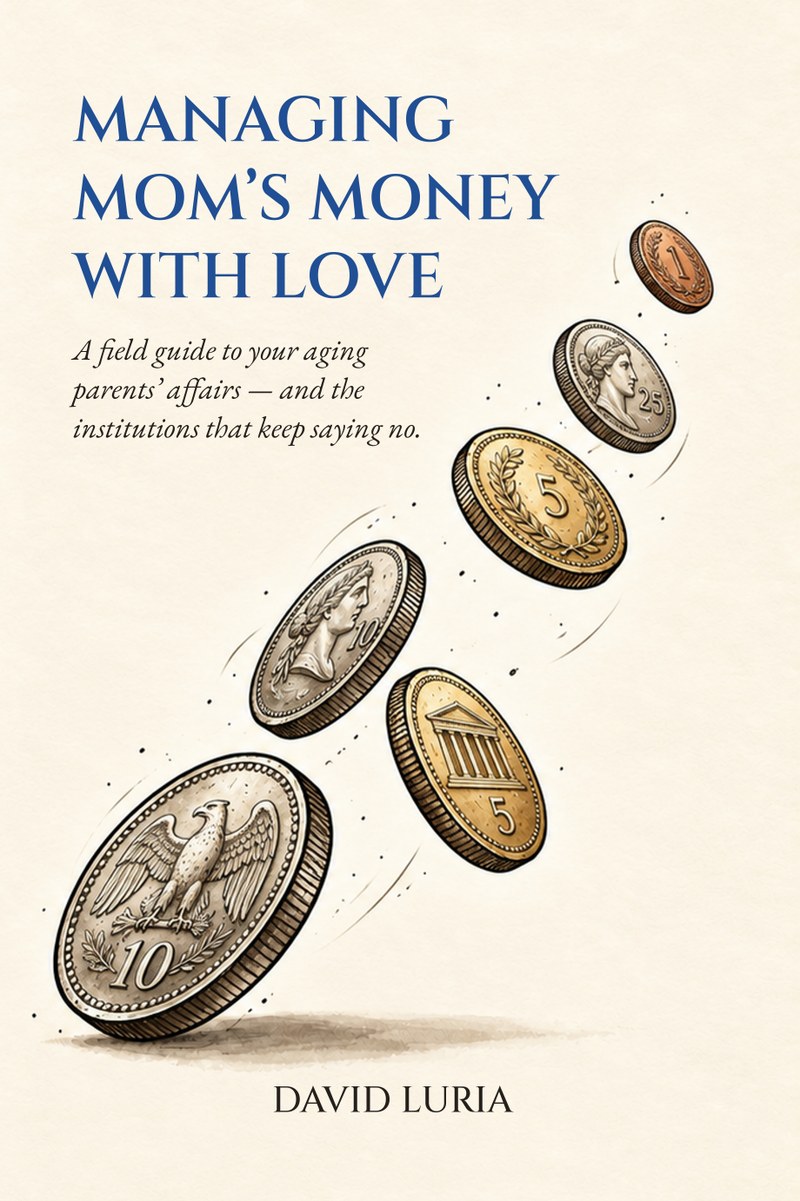
Managing Mom's Money With Love
A field guide to your aging parents' affairs — and the institutions that keep saying no.
Less friction · More time
Tempered Press
A son calls his mother's bank. She is ninety-one, hard of hearing, and sitting a foot away from him.
Nothing went wrong. Everyone behaved correctly. And there was still no way through the door.
A field guide to your aging parents' affairs — and the institutions that keep saying no.
Less friction · More time
No email required. This is Chapter One, as it appears in the book.
From Chapter One · The Login
Four months later the renewal notice came.
It came by mail, because everything from that bank comes by mail, and it said what those notices say. The CD matures on such-and-such a date. If we don't hear from you, it rolls into a new term at the current rate. If you want anything else to happen, tell us before then.
I read it twice. Then I looked at the date.
I could not log in, because there is no login. I could not send a secure message through the portal, because the portal is the thing you get after you log in. I could call, and I did.
Here is the arithmetic of that call. My phone puts the elapsed time at the top of the screen, and I watched it the entire way. The overwhelming majority of that time was spent establishing that my mother was my mother — the date of birth, the last four, the address on file, the security question she chose in a decade when she could still hear the question being asked. Every one of those exchanges went through me twice. He asked. I relayed. She answered. I relayed back.
Eleven minutes, twenty-two seconds.
The banking part took about ten seconds.
I don't blame anyone for the verification. It exists because people steal from the elderly, which is a thing that happens to people exactly like my mother, and a bank that skipped it would deserve everything that followed. The man on the phone didn't write the script. My mother didn't ask to lose her hearing. There was nobody in that call to be angry at, which is its own particular kind of frustrating — a slow boil with no one to hand it to.
But I would like the people who design these systems to sit at this table once. Not read a report. Sit here, with the speakerphone on, and watch a ninety-one-year-old woman spend eleven minutes proving she is herself in order to be told one sentence.
Here's what I want you to notice, because it took me a while to see it myself. Nothing had gone wrong. There was no error, no lost paperwork, no rude representative. Every single party in this was behaving correctly. The bank had a policy. The policy had a reason. My mother had a preference and got what she paid for. The man on the phone was helpful. The notice arrived on time.
And I still didn't have a way through the door.
The full chapter runs the collision to its end — and gives you the three questions that would have opened the door a season earlier.
Part One proves the pattern — nine walls where the system says no to someone doing everything right.
Part One · The Collisions
Then the book stops collecting walls and teaches you to read them — so the tenth wall, the one that isn't in any book, doesn't cost you a week.
Part Two · The Diagnostic
Part Three · Public vs. Private
Social Security does not recognize your power of attorney. The IRS has its own forms. Each government door has its own key — and almost nobody learns this before they're standing at the door.
"The reason there is no login is not that the bank is behind. It's that you are not a customer."
The sentence the whole book hangs on — and the beginning of every route through.
I'm her son. She's sitting right next to me.
I have the power of attorney. Why won't you accept it?
We did all the paperwork. Why are we starting over?
Then this book was written at your kitchen table. You're not confused — you're being stonewalled. There's a difference, and there's a method.
Out now on Amazon. Want a note when the next book ships?
Confirm your address by email, then we'll send a note when a new book ships. Unsubscribe any time. No phone number. Your address is never sold. Privacy.