Can I file my mother's taxes for her — and does the IRS accept a power of attorney?
Published by Corso & Alexander · About David Luria · Updated
The people and first-person scenes in this article are fictional/composite examples, created to illustrate the issues. They are not the author’s personal history. The scenes illustrate caregiving situations; they are not evidence of clinical or legal outcomes.
You can help prepare your mother’s tax return, but preparing it, signing it and representing her before the IRS are different permissions. Form 8821 allows access to specified tax information, not representation. Form 2848 can authorize an eligible representative, including certain family members. Signing her return requires separate authority and is allowed only in limited circumstances. If she cannot sign an authorization, ask her tax adviser or attorney which existing authority or fiduciary process applies; do not assume that being her child is enough.

Here is the afternoon I learned all of that, in a drugstore parking lot.
Can a power of attorney file an income tax return?
The letter came in a windowed envelope with my father's name on it and a thirty-day clock inside. In the corner it said CP2000, which I later learned is what the IRS calls it when a computer notices that a number on your return does not match a number somebody else reported about you. In Edward's case the number was a pension he had earned over thirty-one years, and it did not appear anywhere on his return. They wanted to know why, within thirty days of the date at the top. The date was already eleven days old when I opened it, because the letter had gone to his house first, and his mail reached me in a grocery bag once a week.
I had done this the right way. Fourteen months earlier, at his kitchen table, with a notary and a pen he kept clicking, Edward had signed a durable power of attorney that ran eleven pages and used the word including more times than seemed strictly necessary. His lawyer said it covered everything. I had used it at the credit union, where a teller photocopied it, stapled it, and never mentioned it again. I had a folder, and the folder had a tab, and on the tab I had written POA in marker, which tells you something about the kind of person I had become that year.
I called the number on the letter at 8:12 in the morning, which a forum had said was the trick, and waited thirty-one minutes anyway. When the woman answered I had my speech ready. I was Edward's son. I was his agent under a durable power of attorney. I could read her any part of it she liked.
She was kind about it. That is the part I remember. She said she was not able to discuss the account with me. When I started in about the eleven pages and the notary and the eleven days already gone off the clock, she said it again, more gently, which was somehow worse. Then she told me what I needed, fast, the way you say something you have said four hundred times: twenty-eight forty-eight, or eighty-eight twenty-one.
I wrote both numbers on the back of the envelope. Then I sat in my car with the engine off, thinking: he signed a document in front of a notary that says I can do this. And the federal government wants a different piece of paper.
It does. And once you see why, it stops feeling like an insult and starts looking like what it is, which is a key.
Does the IRS accept a power of attorney?
The woman on the phone was not deciding whether I was a good son. She was deciding whether I was on a list. Two separate questions live inside a call like that one, and the IRS answers them with two different forms. The first is may we tell this person anything at all. Your parent's tax information is confidential by law, from everyone, and everyone includes you. That rule was tightened in the 1970s after a president's people were caught trying to use tax files against his enemies. The wall standing between you and your father's account was built to protect him from the government, and it has no setting for unless he is eighty-one and you are the one paying his gas bill.
The second question is may this person speak and act in the taxpayer's place: answer the notice, agree to a correction, sign something. Those are not the same permission, and the IRS offers different authorization routes. A taxpayer may also give limited oral disclosure consent for a conversation; that does not create standing authority to represent them. The file is the Centralized Authorization File, the CAF: the list of who may see and who may act, for whom. The appropriate authorization depends on the task, not simply on appearing in that file.
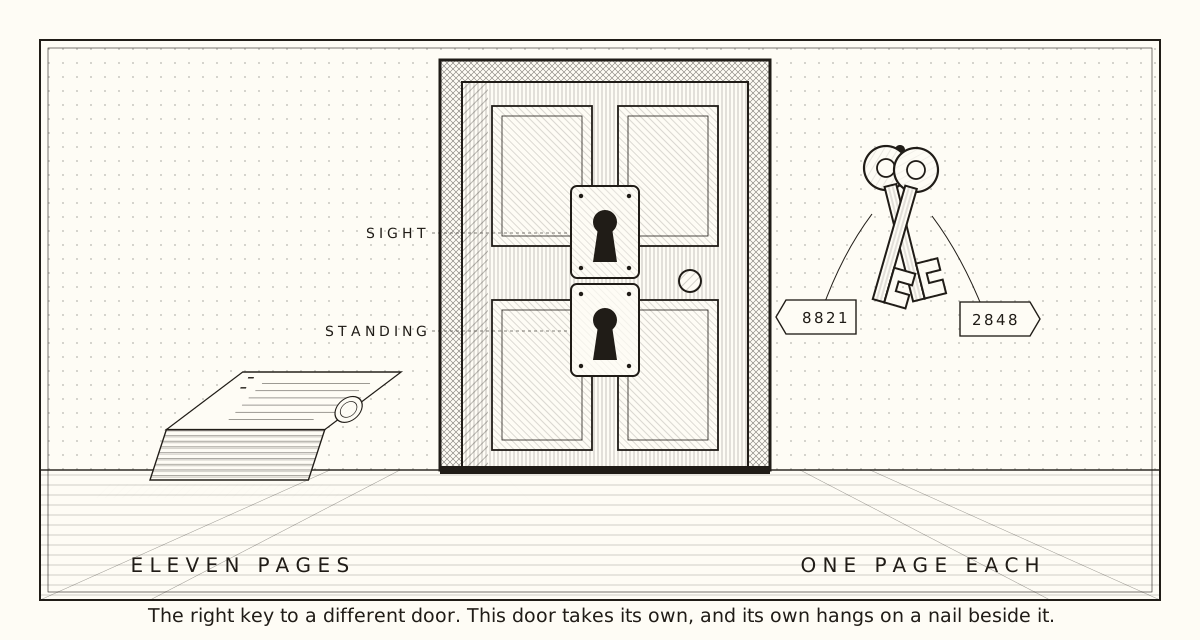
Form 8821, Tax Information Authorization, gets you sight. A person your parent names can inspect and receive tax information: notices, transcripts, the account as it actually stands. That person cannot argue, agree, settle, or sign anything. Its great virtue is that it will take anybody.
Form 2848, Power of Attorney and Declaration of Representative, gets you standing. The person your parent names can represent them: respond, negotiate, agree, sign certain documents. It carries sight along with it. The catch is that only people eligible to practice before the IRS can be named, and that list reads like a wall: attorney, CPA, enrolled agent, enrolled actuary.
Read further down the form. Past the professionals, where the representative has to declare what they are, is item (f): Family Member. Spouse, parent, child, brother, sister, grandparent, grandchild, and the step-versions of each.
You are on the list. Not because you are helpful, not because you have the folder. Because the form says child, and you are one. That one line is the difference between hiring someone to make this call and making it yourself, and almost nobody knows it is there because the form is written for accountants and nobody hands it to families.
So does the IRS accept a power of attorney? Yes, but not like that, and not until it is on the list. It will accept a power of attorney that is not its own form, but only if the document contains what its rules require, and even then it cannot be recorded in the CAF unless a completed Form 2848 is attached. A durable power of attorney drawn up for estate planning may or may not clear that bar. Whether yours does is a question for the lawyer who wrote it, not for this page.
One relief while we are in here: a representative may not endorse or cash a refund check. Worth knowing before a sibling asks.
How do I file a power of attorney with the IRS?
I will tell you what the form asked of us and what we did, because that is what I can vouch for. Your own family's paper is between you and the person who drafted it.
First it made us decide which permission we needed. My sister only wanted to see the notices and pull the transcripts, so she went on an 8821. I needed to answer the letter myself, so I went on a 2848. Filing the second did not cancel the first. One sibling watching, one speaking, on purpose.
It made us do one parent at a time. My parents filed a joint return, and I had assumed that meant one form with two names. It does not. Each spouse executes their own Form 2848, and the IRS online submission service requires one form per upload. That upload rule is not a general claim about what can share a mailing envelope.
It had a line for me already. In the declaration section I entered designation (f) and my relationship to the taxpayer: Son. Where it asked for my CAF number and I had never had one, I wrote None, and they issued me one. A small, strange moment: the government assigning me a number for the job of being somebody's kid.
It wanted me exact on line 3 and it punished thoroughness. Three things: the matter, Income; the form, 1040; and the years, by name. "All years" is on the IRS's own published list of rejection reasons. I listed the year the notice was about and the years on either side, because the next letter is rarely about the same year.
It asked me to check line 6 before I sent it. The second time, I did. More on the first time below.
It cared how it was signed. Faxed or mailed, it needs real ink. Signed electronically, it goes up through the IRS's own online submission, which means an account first, and I set mine up on a night when I had an hour and my patience intact, not the night I found the notice. After Edward signed, I had forty-five days to sign as his representative. I signed it the same afternoon.
Then we sent it, and I learned to watch the status page instead of the mailbox. Nobody calls. I kept a copy of exactly what went out, because you need it to revoke: write REVOKE across the top, sign and date under it, send it back the way it came.
If you have read the first note in this series, about why the bank would not take the same eleven pages, you will recognize the shape. The bank's no was a product decision. Social Security's no is structural, with its own program and its own interview. The IRS's no is not until it is on the list. Three doors, three keys, and almost nobody finds this out until they are standing at the door holding the wrong one.
How to file taxes for a parent with dementia: the deadline nobody prints
Everything above assumes your parent can still sign. Mine could, that first year. This part is about the year he couldn't.
There is a shape to this errand that will feel like incompetence when it is actually design. Everything at the IRS is built around a taxpayer who opens his own mail, signs his own forms, and can be asked. You are doing this for someone who can't, and every place the process chafes is that gap.
The forms sit in a queue. The IRS says so itself; it posts a processing status page for Forms 2848 and 8821 and warns that submissions may be delayed however you send them. You get an email saying the form arrived, and none saying it has been processed. You find out your authorization went through by calling and discovering that this time the person will talk to you, which is a strange way to learn anything. The thirty-day clock on your parent's notice does not know about any of this and does not care.
But the queue is not the real deadline. The 2848 has to be signed by the person whose memory is the reason you are filing it. Every month that goes by, that signature gets harder to get, and there is a point past which it cannot be gotten at all. That is not a scheduling problem. That is the deadline, and it is not printed anywhere.
When Edward could no longer sign anything, we did not start over. We used the eleven pages. We sent a copy of his durable power of attorney with a Form 2848 attached, and I signed the declaration section as his son. He did not sign the 2848, because he had already signed the document it was attached to. What made that work was not my cleverness and it was not the folder. It was that his lawyer had read the IRS's requirements for a power of attorney that is not the IRS's own form, and had written the thing to meet them, fourteen months earlier, at a kitchen table, over ninety minutes and a fee we complained about in the car on the way home. I have thought about that fee a number of times since. Whether the document in your folder does the same is a question for the person who drafted it, and the honest answer might be no. Then the road runs through a court appointment and a different form, Form 56, on which a guardian or trustee tells the IRS they now stand in the taxpayer's place rather than speaking for him. That road takes months, and it belongs to their attorney, not to a page like this one.
And here is the distinction that surprised me most. Signing his return was a separate permission from representing him. The rules allow another person to sign someone's income tax return only in narrow circumstances, disease or injury among them. The 2848 has a box for it and a required sentence that has to be written in almost exactly. The year Edward was in rehab, our accountant wrote that sentence, because a wrong word there lands on a return with my father's name on it. That was money, and a filed return, so we paid someone whose signature goes next to ours. I would do it that way again.
So, can you help with your mother’s taxes? Yes, but match the authority to the task. If she can no longer sign, a qualifying existing power of attorney or a fiduciary appointment may provide a route. Ask her adviser which applies before signing or submitting anything on her behalf.
What it cost when it went wrong
Rejection costs more than delay, because it costs the whole cycle again. The reasons the IRS bounces these forms are humbling in how small they are: a signature with no date beside it, a line 3 that says "all years," the box on line 6 checked with no copy attached. None of that is a judgment about your family. All of it sends the envelope back to the start of a queue you cannot see, and the rejection notice is addressed to your parent.
Ours was line 6, and it was worse than a rejection.
A new Form 2848 recorded on the file will generally revoke the earlier one for the same matter. My mother's accountant of nineteen years was already on that file. I did not check line 6, and I did not attach a copy of his form, and I had just quietly removed the one person alive who understood her return. He was not told. I found out the next time I asked him something and he said the IRS would not talk to him anymore. Then I got to explain to my mother why the man who had done her taxes since the Clinton administration had been fired by her son.
He was gracious. We filed again, with the box checked and his form attached, and waited through the queue a second time. That is the cost of a checkbox: three weeks, an apology, and a phone call I still think about.
Two questions this is not
Can I claim my mother as a dependent? is about your return, not hers, and I have not written about it. My mother passed away, can I file her taxes? belongs to executors and estates, a subject the book this comes from has deliberately kept out. Neither is the one about the letter with the thirty-day clock. That one is this page.
The landing
The letter got answered. Not in thirty days. Closer to ninety, with a phone call in the middle where a man agreed the clock could wait, and a correction that came to about four hundred dollars and none of the panic I had spent on it.
What I would go back and tell myself, sitting in that parking lot with a phone number written across my father's address, is that the document in the folder was never the wrong document. It was the right key to a different door, and this door takes its own, and the IRS forms and instructions are free to read on its website.
Arrange appropriate authority while your parent can still make that decision. Keep the deadline on any IRS notice in view as well; an authorization request does not suspend it.
If you are earlier in this than I was, still at the bank window, still hearing a no you cannot read, the first note in this series explains how to tell one kind of no from another, and it is the place to start. This page is only about the one door with the two keys.
Sources and further help
- IRS: instructions for Form 2848
- IRS: instructions for Form 8821
- IRS: submitting authorizations online
- IRS: power of attorney information
Source links checked September 20, 2026. This article offers general information; the linked authorities explain the rules and guidance in more detail.
This is the idea at the center of one chapter of Managing Mom's Money With Love, the second Tempered Press book, out now on Amazon. The first, When the Keys Go, is at the typesetter. One email when a book ships. Nothing between.
The books
- When the Keys GoA 2 a.m. guide to caring for your aging parents — and forgiving yourself. out now on Kindle.Buy on Amazon now
- Managing Mom's Money With LoveA field guide to your aging parents' affairs — and the institutions that keep saying no. out now on Amazon.Buy on Amazon now
One email when a book ships. Nothing between. Unsubscribe any time; never sold or shared.