Can meditation replace sleep — and is meditation as good as sleep?
Published by Corso & Alexander · About David Luria
Meditation cannot replace sleep, and the research quoted to say it can does not say it. What the evidence shows is narrower and still worth having: forty minutes of meditation can make a tired brain measurably sharper for about an hour, roughly as a strong coffee can, and a handful of people who have meditated for hours a day over many years appear to sleep an hour or two less than the rest of us without obvious harm. Nobody has shown that meditation performs the work sleep performs, which is to clear the chemistry of a day's waking from the brain, consolidate what was learned, and reset the systems that keep you alert. An hour of meditation is not four hours of sleep, and the person who trades sleep for sitting will not feel the bill, which is the dangerous part. Meditation is good before sleep and good instead of lying awake. It is not good instead of sleeping.
Is meditation as good as sleep?
No, because they are not doing the same job, and the difference is not a matter of degree.
Sleep is a maintenance state with a chemistry of its own. While you are awake, a molecule called adenosine accumulates in the brain as a by-product of the energy your cells burn; it is one of the signals that make you sleepier the longer you are up. In 1997 Tarja Porkka-Heiskanen and colleagues at Harvard showed in Science that adenosine rises in the basal forebrain of cats across prolonged waking and falls again during sleep, the mechanism behind something everyone knows from the inside: the pressure to sleep builds with hours awake and is relieved by sleeping, not by resting. Caffeine works by blocking adenosine's receptors so the signal cannot be read. It does not remove the adenosine. Nothing but sleep does.
Sleep also does physical housekeeping that waking cannot. In 2013 Lulu Xie, Maiken Nedergaard and colleagues at the University of Rochester reported in Science that in sleeping mice the space between brain cells expands by about sixty percent and the flow of fluid through it increases, flushing out waste that builds up during waking. How far the mouse result transfers to people is still argued, but no one has proposed that sitting with your eyes closed opens the same channels. Sleep, especially its deep, slow-wave stages, is also when the day's learning is replayed and filed.
Meditation is a wakefulness practice. In the Buddhist traditions it comes from, the point is to stay awake with less noise, and the laboratory picture matches: it lowers physiological arousal, slows the breath, and over time changes how readily attention is captured. Those are real effects, and the earlier note on whether meditation actually works sets out how large they are. None of them is sleep. Comparing the two is like asking whether tidying the desk is as good as paying the bills. Both are worth doing. One is not optional.
Can meditation substitute for sleep — even partially?
Partially, in one narrow sense, and the one study that shows it is usually quoted without its limits.
In 2010 Prashant Kaul, Jason Passafiume, Craig Sargent and Bruce O'Hara of the University of Kentucky published a paper in Behavioral and Brain Functions with the careful title "Meditation acutely improves psychomotor vigilance, and may decrease sleep need." Its first study took ten university students aged nineteen to twenty-three, none of whom had meditated before, gave them two hours of training in a breathing practice, and tested them with the psychomotor vigilance task, a ten-minute reaction-time test that is the standard laboratory measure of sleepiness. Each student did forty minutes of meditation, of napping, or of a control activity on different days, with the test given before, ten minutes after, and an hour after.
All ten improved on the test after meditating. Nine of the ten got slower after the nap, which the authors attribute to sleep inertia, the grogginess that follows a short sleep. Then the students were kept awake for about thirty-two hours and tested again. Their baseline reaction time had slowed, from 255 milliseconds to 289, and forty minutes of meditation still improved it, with fewer lapses, the long gaps in attention that sleep-deprived people produce.
That is the whole of the first finding: a short-term lift in alertness on a reaction-time test, lasting about an hour, in ten young people trained for an afternoon. It is real and it is useful. If you are tired at three in the afternoon and have forty minutes, a sit may serve you better than a nap, because you will not wake groggy. But an hour of improved vigilance is what you get from a cup of coffee or a brisk walk, and nobody argues that coffee replaces sleep. The test measures whether you can press a button quickly, not whether the adenosine has gone or the day's memories have been filed. The authors wrote that whether meditation "can actually replace a portion of sleep or pay-off sleep debt is under further investigation," the scientist's way of saying they had not shown it.
Can deep meditation replace sleep?
The second half of the same paper is where the "monks need less sleep" claim comes from, and it rests on seven people.
Kaul and his colleagues tracked the sleep of seven long-term meditators from the Delhi region of India, aged twenty-four to forty-eight, each with at least three years of practice at two or more hours a day. Using sleep diaries and wrist actigraphs over fifteen days, they found the meditators slept an average of 5.2 hours a day, against 7.8 hours for twenty-three age- and sex-matched non-meditators. On the multiple sleep latency test, where you lie down in a dark room and the clock runs until you sleep, the meditators took 18.25 minutes on average, a well-rested number; a sleep-deprived person is gone in five. The authors' reading was that the meditators "may be replacing one to three hours of sleep with meditation," and that long practice "may also provide a longer term reduction in sleep need roughly equal to the time spent in meditation."
Read the hedges. "May," twice, on a sample of seven, with no random assignment and no way to know what those seven were like before they took up the practice. Three explanations fit the data as well as the headline's.
The first is that meditation deepens sleep rather than replacing it. A 2012 review in Frontiers in Neurology by Ravikumar Nagendra, Nirmala Maruthai and Bindu Kutty of the National Institute of Mental Health and Neurosciences in Bangalore summarizes sleep-laboratory studies of Vipassana meditators in which slow-wave sleep, the deepest stage, held up with age as it does not in non-meditators: between fifty and sixty the meditators spent about 10.6 percent of the night in slow-wave sleep, against 3.9 percent for controls. If a practice buys you more deep sleep per hour, you might need fewer hours, a more modest claim than the one on the podcast.
The second is selection. People who keep up two hours a day of meditation for years are not a random sample. They tend to keep early hours and live quieter lives than the controls, and some of them may have been short sleepers to begin with. Natural short sleepers exist. In 2009 Ying He, Ying-Hui Fu and colleagues at the University of California, San Francisco, reported in Science a mother and daughter who carried a mutation in a gene called DEC2 and slept about six and a quarter hours a night without the deficits short sleep produces in the rest of us. Such people are rare and do not need a practice to sleep less. They would, however, find one easier to sustain.
The third is that the meditators were carrying a deficit they could not feel, which brings us to the most important study in this subject, and it is not about meditation at all.
Why you would not notice if it were not working
In 2003 Hans Van Dongen, David Dinges and colleagues at the University of Pennsylvania published in the journal Sleep a study with a plain design and an unsettling result. Forty-eight healthy adults were kept in the laboratory for two weeks and allowed four, six or eight hours in bed a night, with a separate group kept awake for three nights. Every day they took the same reaction-time test the Kentucky students took, and every day they rated how sleepy they felt.
Performance in the four-hour and six-hour groups declined steadily across the fortnight and had not leveled off when it ended. After two weeks on six hours, the subjects' lapses of attention matched those of people awake for a full night; after two weeks on four hours, people awake for two. The sleepiness ratings did not keep pace: they rose in the first few days, then flattened, while the scores went on falling. The authors' phrase was that the subjects were "largely unaware of these increasing cognitive deficits." The feeling of being fine had come apart from being fine.
This is the part that matters for anyone thinking of trading an hour of sleep for an hour of practice. The one instrument you have for judging the trade, how you feel, is the one the data say is broken under exactly these conditions. The seven Delhi meditators felt fine and their sleep latency test agreed; that is reassuring as far as it goes, and it does not go as far as a year of your life. The earlier note on why the mind races all the time covers what short sleep does to the daytime mind; the point here is that the damage does not announce itself.
Do monks sleep less?
Some do, by rule, and the traditions are honest about what that costs.
Monastic timetables in most contemplative traditions start before dawn, and retreat schedules in the Zen and Theravada lineages routinely allow five or six hours of sleep against ten or more of sitting. Less often quoted is that the same traditions have a vocabulary for what happens: drowsiness is listed among the classical hindrances to meditation, and the instruction when it wins is to stand up, walk, or go to bed, not to persist in the belief that the sitting is doing sleep's job. A tradition that thought meditation replaced sleep would not need techniques for staying awake during it.
The laboratory adds one finding that cuts the other way from the headline. In 2010 Willoughby Britton and colleagues at the University of Arizona published in Psychosomatic Medicine a trial in which twenty-six people with partially remitted depression were randomized to an eight-week mindfulness course or a waiting list, with full sleep-laboratory recordings before and after. The meditators reported sleeping better, though no better than the controls. The recordings told a different story: the people who practiced showed more awakenings, more light stage-one sleep and less slow-wave sleep than the controls, and the more they practiced, the larger the shift. Britton's reading was that mindfulness practice is, at bottom, training in wakefulness, and that some of it carries over into the night. It is the opposite of what a sleep substitute would do.
So some monks sleep less because they have decided to, their practice may deepen what sleep they get, and the practice itself leans toward wakefulness. That is a disciplined life, not a loophole in biology.
Can meditation replace REM sleep?
No, and this is the clearest no in the subject.
Rapid-eye-movement sleep is a specific state with its own signature: the large muscles go slack, the eyes move under the lids, the brain's rhythms look closer to waking than to deep sleep, and most vivid dreaming happens there. When people are deprived of REM specifically, by being woken whenever they enter it, the brain fights back: on the next undisturbed night it enters REM sooner and stays longer, a rebound that shows the state is being tracked and its loss made up. Nothing of the kind has been shown for meditation, because meditation is not REM. Fabio Ferrarelli, Richard Davidson, Giulio Tononi and colleagues at the University of Wisconsin reported in PLoS ONE in 2013 that experienced meditators showed more high-frequency gamma activity in the back of the brain during non-REM sleep than non-meditators: evidence that a practice changes the sleeping brain, and none that it replaces any stage of it.
Can yoga nidra replace sleep?
Not on the evidence, and the evidence is thinner than the claim's popularity would suggest.
Yoga nidra, "yogic sleep," is a guided practice done lying down, in which attention is moved through the body while the practitioner stays, in theory, awake at the boundary of sleep. It has lately been repackaged as non-sleep deep rest, and the claim that travels with it, that an hour equals several hours of sleep, has been made for decades without a study to support it. The best trial so far is modest in both design and result. In 2020 Esther Moszeik, Timo von Oertzen and Karl-Heinz Renner of the University of the Bundeswehr in Munich published in Current Psychology a randomized waiting-list study in which 341 people did an eleven-minute yoga nidra recording daily for thirty days, against 430 controls. Stress, negative mood and mindfulness all moved in the right direction, by small amounts; the effect on self-reported sleep quality was 0.13, a shift from 1.00 to 0.90 on a scale that runs to eighteen. Nobody's sleep was measured with anything but a questionnaire. The authors called the effects "very small to small."
What yoga nidra plainly does is lower arousal, a reasonable thing to want at eleven at night. People in the Munich study said they used the recording to fall asleep, which is sensible, and the reverse of using it instead of sleep. If you have twenty minutes at midday and a practice that leaves you rested, use it. Count it as rest. Do not subtract it from the night.
Is meditation good before sleep?
Yes, and this is where the two belong together.
The condition that keeps most people awake is not a shortage of tiredness but a surplus of arousal: the heart going, the mind running the day's inventory, the body braced as though for something. Meditation lowers exactly that. A small 2015 trial by David Black and colleagues at the University of Southern California, discussed in the earlier note on meditation, found that six weeks of a mindfulness program improved sleep quality in older adults more than a sleep-hygiene class did, and later reviews have found the same modest improvement, strongest in people who sleep badly to begin with. The note on why the mind races at 2 a.m. covers that hour directly.
The practical rule is short. Meditate to fall asleep, if it helps. Meditate in the afternoon, if it leaves you clearer than a nap would. If you fall asleep while meditating, you have had a nap, which is fine. What you should not do is count the sitting as sleep and shorten the night to make room for it.
What it costs when the trade goes wrong
The cost is invisible to the person paying it, which is the only reason the myth survives.
Put the two findings side by side. Van Dongen showed that two weeks of six-hour nights produce the impairment of a night without sleep, and that the people impaired did not know it. Kaul showed that forty minutes of meditation makes a sleep-deprived person test better for an hour. A person who acts on the second study, cutting the night by an hour and sitting for an hour, will feel the improved vigilance and will not feel the accumulating deficit, because the first study says feeling is exactly what fails. They will report, and believe, that it is working. Their reaction times, their memory for the meeting and their odds on the drive home will say otherwise, and nobody will connect the two, because the practice feels good.
The people for whom this matters most are the ones most drawn to it: the new parent, the person with a job and a sick parent and no hours left, who hears that meditation can replace sleep and hears, underneath it, a way to get the time back. There is not. There is a way to get more out of the time, which is to sleep the hours you can and use a short practice to make the waking ones calmer.
What is the one thing to hold on to?
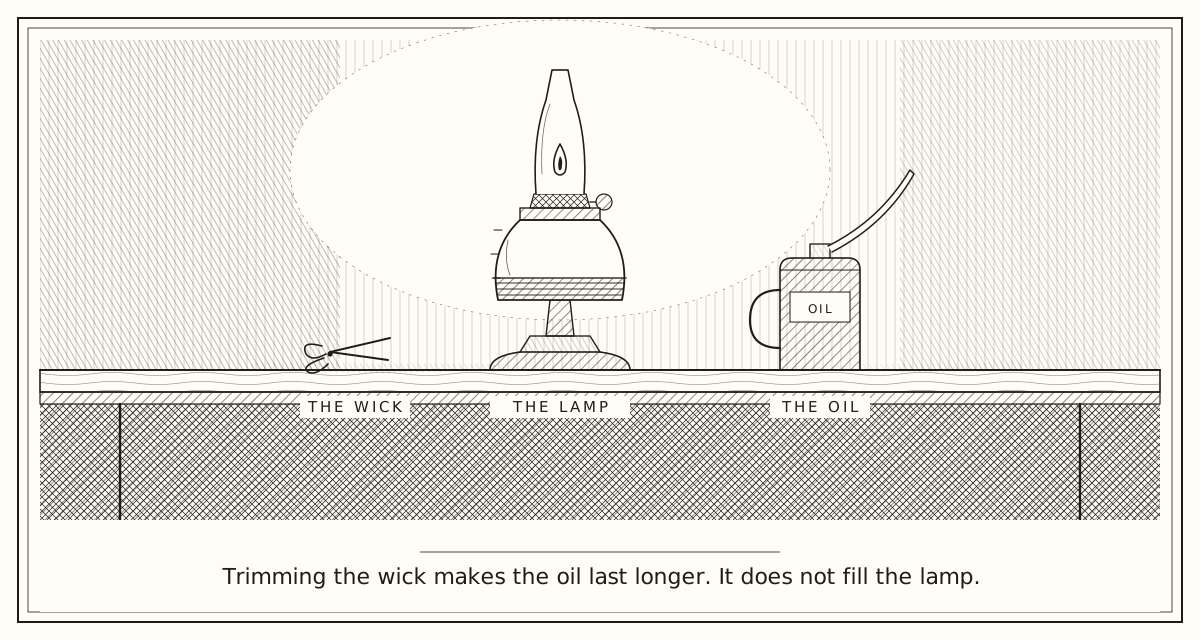
That you can trim the wick and you cannot refill the lamp. A lamp turned low burns cleaner and lasts longer on what it has; that is what a practice does to a day, and it is worth doing. The oil still goes down. Only sleep fills it, and the gauge you would use to check, how you feel, reads full long after the reservoir is not. Sit if sitting helps you. Sit before bed if it gets you there. Then go to bed, for as long as you were going to.
One email when a book ships. Nothing between.
One email when a book ships. Nothing between. Unsubscribe any time; never sold or shared.