Does meditation actually work — and does it actually change the brain?
Published by Corso & Alexander · About David Luria
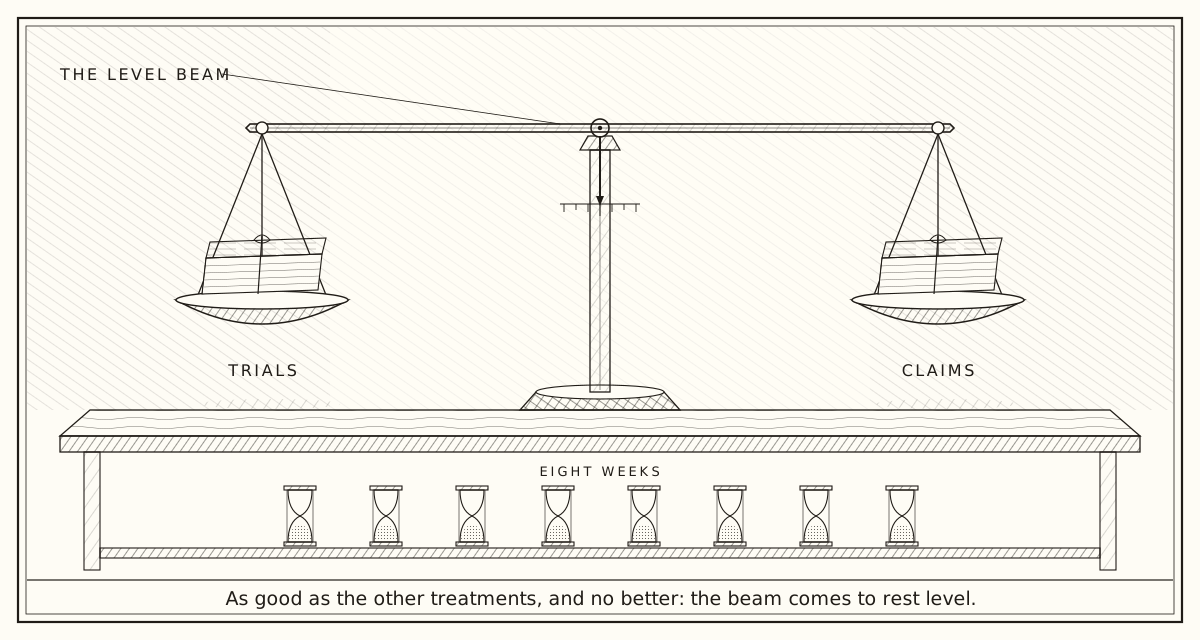
Meditation actually works, within limits that are narrower than its reputation and wider than its critics allow. The best evidence, from dozens of randomized trials pooled across several large reviews, is that eight weeks of a structured mindfulness program produces small-to-moderate improvements in anxiety, depression and pain, about the size that other active treatments produce, and no larger. It helps sleep in people who sleep badly. It does not reliably lower stress hormones, it has not been shown to change the brain's structure in the eight weeks most people give it, and it has side effects that are real for a minority. The honest summary is that meditation is a modest, repeatable treatment with an evidence base comparable to a good talking therapy, not a transformation and not a placebo.

The rest of this note is the evidence, condition by condition, and where the claims outrun it.
Does meditation actually do anything?
Yes, and the size of the something has been measured carefully. The reference point for every serious discussion is a 2014 review in JAMA Internal Medicine led by Madhav Goyal of Johns Hopkins, commissioned by the U.S. Agency for Healthcare Research and Quality. The team began with more than 18,000 citations and kept only randomized trials with an active control group, meaning the comparison condition took the same time and attention as the meditation program. That filter removes the trials in which meditation beat a waiting list, which almost anything does, and leaves the harder question: is meditation better than doing some other structured thing for eight weeks?
Forty-seven trials survived, with 3,515 participants. Across them, mindfulness programs showed moderate evidence of improved anxiety, with an effect size of 0.38 at eight weeks and 0.22 at three to six months; improved depression, at 0.30 and 0.23 over the same intervals; and reduced pain, at 0.33. The evidence for reduced stress and distress, and for better mental-health-related quality of life, was rated low. For attention, substance use, eating, sleep and weight it found insufficient evidence either way. On the question most people are really asking, the authors were plain: they found no evidence that meditation programs were better than any active treatment, whether drugs, exercise or other behavioral therapies.
An effect size of 0.3 needs translating. It is the gap between the average meditator and the average control participant, in standard deviations, and by the usual convention 0.2 is small, 0.5 medium and 0.8 large. The anxiety and depression effects sit between small and medium, roughly the size antidepressants show over placebo in pooled trials, and in the range most psychological treatments produce. Enough to notice in a life. Not enough to call a cure.
A larger synthesis published in 2018 in Clinical Psychology Review, led by Simon Goldberg at the University of Wisconsin, pooled 142 randomized trials with more than 12,000 participants across psychiatric conditions and sorted the comparison conditions into tiers. Mindfulness-based interventions beat no treatment by a clear margin, beat minimal and non-specific active controls by a smaller one, and were no different from established treatments such as cognitive behavioral therapy. Goldberg's group returned to the question in 2022 with a review of forty-four meta-analyses and reached the same shape of conclusion. The effect is there, it is consistent, and it is ordinary in size.
Does meditation actually help anxiety?
Anxiety is where the evidence is strongest, and where the most demanding single trial has been run. In 2023 Elizabeth Hoge of Georgetown University and colleagues published in JAMA Psychiatry the first head-to-head comparison of a mindfulness program with a first-line anxiety medication. Two hundred and seventy-six adults with diagnosed anxiety disorders, recruited at three academic medical centers, were randomly assigned either to eight weeks of mindfulness-based stress reduction or to the antidepressant escitalopram, the generic form of Lexapro and a standard first choice for anxiety.
Two hundred and eight people finished. On the clinician-rated severity scale that was the primary measure, the meditation group improved by 1.35 points and the medication group by 1.43, a difference of 0.07, far inside the margin set in advance for calling the two equivalent. The trial asked whether meditation was no worse than the drug, and it was not. The side effects were not equivalent at all. In the medication arm 78.6 per cent reported at least one adverse event; in the meditation arm, 15.4 per cent.
Two things about that result deserve weight before anyone cancels a prescription. The first is the dose. The program in the trial was the full clinical version: a weekly class of about two and a half hours, a day-long retreat, and forty-five minutes of home practice every day for eight weeks. The trial says nothing about ten minutes on an app. The second is what it does not show: that meditation is better than medication, that it works for severe anxiety, or that it holds up over years. It shows that eight weeks of disciplined practice is a legitimate alternative for adults whose anxiety is bad enough to be diagnosed and who are prepared to do the work.
For the racing, wakeful kind of anxiety rather than a diagnosis, there is a note on this shelf about why a mind races all the time, in which meditation is one lever among several physical ones.
Does meditation help with depression?
For depression that is happening now, the Goyal and Goldberg figures above apply: a small-to-moderate benefit, comparable to other active treatments. The more striking evidence is about depression that keeps coming back.
Mindfulness-based cognitive therapy was designed in the 1990s by Zindel Segal, Mark Williams and John Teasdale to prevent relapse in people who had recovered from repeated episodes. In 2016 Willem Kuyken of Oxford and colleagues published in JAMA Psychiatry a pooled analysis of individual patient data from nine randomized trials, 1,258 patients in all. Over sixty weeks of follow-up, people who had completed the eight-week course were about 31 per cent less likely to relapse than those who received usual care or another comparison treatment, and the benefit held when the comparison was maintenance antidepressant medication. The protection was largest for the people who had been most severely depressed at the start.
That is a specific result for a specific group, people with repeated past episodes who were well at the time of the course, and it should not be stretched into a claim about depression in general. Within its boundary it is one of the better-supported findings in the field, and it is why the course appears in Britain's national treatment guidelines for recurrent depression.
Does meditation help with sleep?
Modestly, and the best single study is small enough that it should be read as encouraging rather than settled. In 2015 David Black of the University of Southern California and colleagues published in JAMA Internal Medicine a trial in forty-nine older adults with moderate sleep disturbance. Half took a six-week course in mindful awareness practices; half took a sleep-hygiene education course of equal length, itself a standard treatment. On the Pittsburgh Sleep Quality Index, where a lower score is better, the meditation group improved by 2.8 points and the sleep-education group by 1.1, with the meditators also reporting less insomnia, less fatigue and fewer depressive symptoms at the end.
The Goyal review, a year earlier, had rated the evidence on sleep as insufficient, and later meta-analyses have landed between the two: a measurable improvement in self-reported sleep quality, strongest in people who sleep badly to begin with, and weak or absent evidence from objective measures. The mechanism is probably not mysterious. What keeps a poor sleeper awake is usually a mind that will not stand down, and what meditation trains is noticing a thought and letting it go without following it. If your problem is the 2 a.m. kind, there is a note on this shelf about what to do when your mind races at 2 a.m. that puts the practice in its place among the other tools.
Does meditation actually change the brain?
This is the claim that has done the most to sell meditation and the one that has aged worst. The study everyone cites was published in 2011 in Psychiatry Research: Neuroimaging by Britta Hölzel, Sara Lazar and colleagues at Massachusetts General Hospital. Sixteen people took an eight-week mindfulness-based stress reduction course and were scanned before and after; compared with a waiting-list group, they showed increased gray matter density in the left hippocampus and in a few other regions associated with learning, memory and emotion regulation. Sixteen people, no active control, and a result reported around the world as proof that meditation rebuilds the brain in two months.
In 2022 Richard Davidson's group at the University of Wisconsin, with Tammi Kral as first author, published in Science Advances what amounts to the replication the field had been waiting for. Two randomized controlled trials were combined, with more than two hundred healthy adults who had never meditated. Participants were assigned to the same eight-week course, to a matched wellness program with no mindfulness content, or to no training, and were scanned before and after. There were no structural brain changes attributable to the meditation course: none in the hippocampus, none in the regions the 2011 study had named, none anywhere the analysis looked. Davidson, who has spent his career studying contemplative practice and is no skeptic of it, said in the accompanying statement that the earlier findings had come from small samples and elective volunteers and that the record should be corrected.
Two cautions keep the correction honest. The null result is about structure, the volume and density of tissue, after eight weeks. It says nothing about long-term practitioners, where differences have been reported, though those compare people who chose to meditate for decades with people who did not, and cannot separate the practice from the kind of person who keeps it up. And it says nothing about function, the pattern of activity while the brain works. Changes in how the brain's default network behaves during attention have been reported after short training, and were the subject of the note on this shelf about why the mind wanders. The honest position in 2026 is that eight weeks of meditation changes what the brain does, measurably if modestly, and has not been shown to change what the brain is.
Does meditation lower cortisol — or actually reduce stress?
The stress claim splits into two questions with two different answers. On stress as people report it, the Goyal review rated the evidence low, which surprises people until they look at the controls: the other structured programs also reduced stress. On stress as the body registers it, a 2017 meta-analysis in the Journal of Psychiatric Research led by Michaela Pascoe pooled forty-five studies and found that meditation practice was associated with lower blood cortisol, lower C-reactive protein, lower blood pressure and heart rate, and lower levels of two other inflammatory and metabolic markers. The individual studies were small and uneven, the authors said so, and several later trials have found no cortisol effect at all. Cortisol is a noisy measure that moves with the time of day, the previous night's sleep and whether a needle is involved.
The fair reading is that meditation probably nudges the body's stress physiology in the right direction, by a small amount, in some people, some of the time, and that nobody should take it up expecting a blood test to prove it. The firmer evidence is the subjective half: people who complete a program say they feel less distressed.
How long does meditation take to work?
Eight weeks is the figure the research keeps returning to, for a mundane reason: it is the length of the standard course Jon Kabat-Zinn designed at the University of Massachusetts in 1979, and most trials test that course or a derivative. The eight-week benefits are therefore well documented and the shorter ones much less so.
The best evidence on a smaller dose is a 2019 study in Behavioural Brain Research led by Julia Basso at New York University. Adults with no meditation experience practiced a guided meditation for thirteen minutes a day. After four weeks there were no measurable changes against a control group who listened to a podcast for the same time. After eight weeks the meditators showed lower negative mood, lower state anxiety and improved attention and working memory. The lesson is not that thirteen minutes is magic but that duration matters more than intensity: the group that got a result was the one still going in week eight.
The Hoge trial's dose, forty-five minutes a day with a weekly class, carries the strongest clinical result. Whether a quarter of that dose produces a quarter of the effect is not known; the trial has not been run. A person deciding whether to try it should expect to practice most days for two months before judging, and should judge on how the weeks went rather than on how any single sitting felt.
Why meditation doesn't work for everyone
Because it is a treatment, and no treatment works for everyone, and because this one has been studied in a way that for many years hid its failures. In 2018 fifteen researchers from across the field, with Nicholas Van Dam as lead author, published a paper in Perspectives on Psychological Science under the title "Mind the Hype." They catalogued the problems: one word, mindfulness, used for a dozen practices; questionnaires that ask people to rate their own mindfulness, which trains the expected answer; small samples; weak controls; and a research culture that published positive results and sat on the rest. A 2016 analysis in PLOS ONE by Stephanie Coronado-Montoya and colleagues had already found the published trials positive far more often than their statistical power could explain, a pattern that points to selective reporting.
The harms were under-reported for the same reasons. In 2021 Willoughby Britton of Brown University and colleagues published in Clinical Psychological Science the first study to look for them properly in ordinary mindfulness classes rather than on retreats. Among ninety-six participants in standard eight-week programs, 58 per cent reported at least one meditation-related adverse effect, most often anxiety, intrusive memories, numbing or a feeling of unreality. Thirty-seven per cent reported effects that impaired their daily functioning, and 6 per cent reported impairment that lasted more than a month. Britton has put the figure in context: 6 per cent is in line with what psychotherapy produces, and it argues for screening and informed consent, not alarm. A 2020 systematic review in Acta Psychiatrica Scandinavica by Miguel Farias and colleagues, pooling fifty-five studies, put the prevalence of adverse events at a little over 8 per cent in the experimental studies that measured them.
Who is at risk is still being worked out. People with a history of trauma, psychosis or dissociation appear more likely to have difficult experiences, particularly in long or intensive practice; turning attention inward toward whatever arises does not suit a mind that arrives already flooded. For such a person the right first move is a clinician, not a cushion. For everyone else the finding is simpler. Some people try meditation, do it as prescribed, and get nothing from it. That is not a failure of character; it is the ordinary distribution of response to an ordinary treatment. Give it the eight weeks, and if the weeks produce nothing, spend the time on something that does.
Why does meditation make me sleepy?
Because you are asking a tired body to sit still with its eyes closed in a quiet room, and the body takes the hint. Meditation lowers arousal by design; in a well-rested person that produces calm alertness, and in a person running on six hours it produces a nap. The fixes are the obvious ones: sit rather than lie down, practice in the morning or after a walk rather than after lunch, keep the eyes slightly open. And read the drowsiness as data. A mind that falls asleep every time it is given nothing to do needs more sleep before it needs more meditation.
What is the one thing to hold on to?
That the word actually in the question deserves a plain answer, and the answer is yes, by an ordinary amount. Forty-seven trials with real control groups, a head-to-head with a first-line drug, a thousand-patient pooled analysis on relapse: the evidence is better than most things people are told to do for their minds, and it describes an effect the size of a decent talking therapy, no larger. The brain-rebuilding claims did not survive a proper test. The side effects are real for one person in sixteen and should be said out loud. None of that is a reason to skip it, or to expect more than it gives. Eight weeks, most days, then look honestly at how the weeks went. The people who measured it have been more careful with the question than the people who sell it.
One email when a book ships. Nothing between.
One email when a book ships. Nothing between. Unsubscribe any time; never sold or shared.