Why does my mind race all the time — and is a racing mind anxiety?
Published by Corso & Alexander · About David Luria
Your mind races all the time because it is running in a state of high arousal, and a brain at high arousal thinks faster, shallower and with less steering than a calm one. The speed is not a sign that you have more to think about. It is a sign of the gear the brain is in. Stress hormones, short sleep, caffeine and a day of unfinished tasks each push the brain toward that gear, and together they can hold it there for weeks. A racing mind is one of the common ways anxiety shows itself, but it is not a diagnosis on its own; it also comes with ordinary overload, with poor sleep, with ADHD, and in a small number of cases with a mood disorder, which has a distinct feel described below. The useful news is that the gear can be changed, and the levers that change it are physical before they are psychological.
The rest of this note is about where the speed comes from, how to tell the ordinary kind from the kind a doctor should hear about, and what slows it down.
What does a racing mind feel like?
People describe it with the same handful of words: fast, loud, crowded, jumping. A plan for the afternoon turns into a conversation from last week, which turns into a bill, and none of them stays long enough to be useful. There is a pressure to it, a sense that the thinking is happening to you rather than being done by you.
Psychiatrists have found it worth splitting in two. In a 2010 paper in the Journal of Affective Disorders, a Geneva group led by Camille Piguet and Gilles Bertschy separated racing thoughts, which move quickly from one subject to the next, from crowded thoughts, in which several things press for attention at once and none of them moves. The two often travel together, but they are different sensations. Crowded is the mind at a switchboard with every jack lit. Racing is the mind on a train that will not stop at any station.
Both are speed problems, not content problems. That matters for what follows. The post on overthinking on this shelf dealt with thought that circles one subject too long; this one is about thought that moves too fast to settle on any subject at all. They overlap in the small hours, but they have different causes and different levers.
Why does my mind race as soon as I wake up — or in the morning?
Because the body is doing something in the first hour after waking that it does at no other time of day, and the mind rides on it.
Cortisol, the main stress hormone, follows a daily curve, and its steepest part is the rise that begins the moment you wake. A 2009 review by Eva Fries, Katarina Dedovic and Jens Pruessner in the International Journal of Psychophysiology set out what is known about this cortisol awakening response: in most people the hormone climbs sharply over the first thirty to forty-five minutes after waking, and the rise is larger on days a person expects to be demanding. It is a mobilization: the body preparing for the day before the day has begun, and part of what it mobilizes is the brain's readiness to attend to threats and tasks. If you wake with a list already running, the list is partly the hormone.
Two other things happen in the same hour. The first is sleep inertia, the grogginess that follows waking, which Patricia Tassi and Alain Muzet reviewed in Sleep Medicine Reviews in 2000. For a period that is usually under half an hour, but can be longer after a short or broken night, the parts of the brain that plan and inhibit are slower to come online than the parts that react. The effect is a mind with the accelerator working and the brakes still warming up. The second is the phone. Most people now meet the day's inputs before they have stood up, and each message is a small open loop the mobilized brain will try to hold. Three of them is a plan. Thirty is a race.
None of that is a disorder. It is a predictable consequence of waking, and it predicts its own remedy, below.
Is a racing mind anxiety?
Sometimes, and the way to tell is to ask what the speed is in service of.
Anxiety is readiness for a threat that has not arrived, and its signature is not more thought but a particular kind of attention. In 2007 Michael Eysenck, Nazanin Derakshan and colleagues set out attentional control theory in the journal Emotion, and its central claim has held up well: anxiety shifts the balance between two systems of attention. One is goal-directed, slow and steered; the other is stimulus-driven, fast and pulled by whatever looks important. Under anxiety the second system gains, and the first loses. The anxious mind is not thinking more things so much as being pulled toward more things, especially anything that might be a problem. Since almost anything might be a problem, the pulling does not stop.
Amy Arnsten at Yale described the same shift from the other end, in the chemistry, in a 2009 review in Nature Reviews Neuroscience. Under stress the brain releases noradrenaline and dopamine at levels that quiet the prefrontal cortex, the region that holds a plan, weighs options and says no to a distraction, while strengthening the older, faster circuits that handle habit and alarm. Her phrase: stress switches the brain from thoughtful, reflective regulation to reflexive, rapid responding. The speed you feel is that switch. Useful in an emergency; expensive when the emergency is an email.
So a racing mind is anxiety when the race keeps returning to what could go wrong, when it comes with the body's other signs of readiness (a tight chest, a stomach that will not settle, shallow breath, trouble sitting still), and when it eases once the feared thing is resolved or ruled out. It is not anxiety in any clinical sense when it is simply a fast, busy, somewhat scattered mind on a day with too much in it, and most racing minds are that. If the readiness has been there most days for months, and it is costing you sleep, work or company, that is the pattern a clinician would want to hear about, and this shelf does not pretend to assess it. A general practitioner can, and does, often.
Is a racing mind a symptom of ADHD?
It can be, and this is more recent knowledge than most of the advice online would suggest.
For decades the clinical description of attention deficit hyperactivity disorder was written for children and emphasized what could be seen: fidgeting, interrupting, leaving the seat. Adults often report that the hyperactivity moved indoors. A Strasbourg group led by Luisa Weiner, who had developed a questionnaire to measure racing and crowded thoughts in mood disorders, gave it to adults with ADHD and published the result in Psychiatry Research in 2021. Adults with ADHD reported racing thoughts far more than people without the condition, and the racing was not explained away by the anxious or depressed mood that often accompanies ADHD. The authors' conclusion was in their title: racing thoughts are an integral symptom of adult ADHD, not a side effect of something else.
The feel of it, as they describe it, is closer to crowded than to fast: several thoughts at once, difficulty choosing which to follow, noise rather than a single accelerating line. The note on this shelf about why the mind wanders touched on the overlap between ordinary wandering and ADHD. In ADHD the wandering is not only frequent but pressured, in quiet rooms as much as busy ones.
So, is a racing mind a symptom of ADHD: on its own, no; a racing mind is too common for that. Together with a long history of losing track of tasks, time and objects that goes back to school, it is one of the things an assessment looks at. The assessment is the doctor's. The pattern is yours to notice.
Racing thoughts vs flight of ideas: when is racing a clinical sign?
One form of racing is a clinical sign in its own right, and it is worth knowing its shape so that you can rule it out, or not.
The diagnostic manual psychiatrists use, the DSM-5, lists among the features of a manic or hypomanic episode a flight of ideas or subjective experience that thoughts are racing. The two phrases describe the same thing from inside and outside. From inside, thoughts come so fast that speech cannot keep up. From outside, a listener hears someone jump from topic to topic along connections that are real but thin, with none of the pauses that normal conversation has. In an episode this comes bundled with other changes: much less need for sleep without tiredness, a mood that is elevated or irritable rather than anxious, more talk, more plans, more confidence than the situation warrants, sometimes more spending. It lasts days, not hours.
Piguet and colleagues, in the 2010 paper mentioned above, argued that the old assumption that racing thoughts belonged only to mania was too narrow. Weiner's group, in a 2019 study in the Journal of Affective Disorders, confirmed it with their questionnaire: people in depressive episodes with anxious or agitated features also reported racing and crowded thoughts, often severe. Racing on its own does not point at one diagnosis. The company it keeps does.
The practical line is this. A fast mind with an ordinary mood, ordinary sleep need and an ordinary sense of your own abilities is a fast mind. A fast mind with three nights of two hours' sleep and no fatigue, a mood that feels unusually high or sharp, and a run of decisions your friends are questioning, is a reason to see someone this week. There are also physical causes a doctor will check and this note will not guess at; an overactive thyroid and some medications are among them. Medication for racing thoughts is a question for a prescriber, after an assessment, not before.
Why does my mind race with thoughts even when nothing is wrong?
Because unfinished business does not need to be important to take up room, and most days generate more of it than they close.
In 1927 Bluma Zeigarnik, then a student of Kurt Lewin's in Berlin, reported that people remembered interrupted tasks about twice as well as tasks they had completed. The effect that carries her name has been argued over since, but a 2011 study in the Journal of Personality and Social Psychology by E. J. Masicampo and Roy Baumeister found the part of it that matters here. People given a task they could not finish were more distracted by it afterward, and their performance on an unrelated reading task suffered. People who were asked to make a concrete plan for finishing the task, but not to finish it, showed no such intrusion. The brain, it seems, does not need the loop closed. It needs to know the loop will be closed, and how. Until it knows that, it keeps the loop open by reminding you, which from the inside feels like a thought that keeps coming back.
Now multiply. Sophie Leroy, in a 2009 paper in Organizational Behavior and Human Decision Processes, gave the name attention residue to what happens when people switch from one task to another before the first is done. Part of the attention stays with the first task, and performance on the second drops while it does. A day of switching among a dozen half-finished things, each with its own residue, produces a mind that is nominally free at seven in the evening and in fact still partly on all twelve. Nothing is wrong. Everything is open.
This is the most common cause of a racing mind in people who are not otherwise anxious, and the one most in your hands, because the remedy is not calm. It is a list.
How to calm a racing mind
The levers are ordered by how much evidence stands behind them and how fast they work. The physical ones come first because the speed is physical before it is anything else.
Take the stimulants seriously. Caffeine has a half-life the U.S. Food and Drug Administration puts at roughly four to six hours, which means half of a two o'clock coffee is still in you at seven, and a quarter at midnight. Caffeine does not create thoughts, but it raises the arousal that makes thoughts fast, and in an already mobilized brain it is the difference between busy and racing. A fortnight with nothing after noon is the cheapest experiment on this list.
Repay the sleep. Short sleep does to the brain something close to what stress does. In a 2007 study in Current Biology, Seung-Schik Yoo, Matthew Walker and colleagues scanned people after a normal night and after a night without sleep while they looked at disturbing images. Without sleep, the amygdala, the brain's alarm center, responded about sixty percent more strongly, and its connection to the prefrontal cortex, which normally talks it down, was weakened. A brain in that state is louder and less governed, which is the racing state. The post on this shelf about the mind that races at 2 a.m. covers the night side. The day side is simpler: a racing mind that has had six hours of sleep for a month is not mysterious.
Move, hard, once a day. A large body of trials shows that a single session of aerobic exercise lowers the state of anxiety that follows it, an effect Steven Petruzzello and colleagues summarized in a meta-analysis in Sports Medicine as early as 1991 and that later reviews have kept finding. The mechanism is not settled; plausibly the same arousal system is being discharged rather than fed. Twenty to thirty minutes at a pace that makes talking difficult is the dose most of the studies used.
Close the loops on paper. This is the Masicampo and Baumeister finding turned into a habit. At the end of the working day, or whenever the racing is worst, write down every open item the mind is holding and, beside each, the single next step and when it will happen. Not the whole plan. The next step. The intrusion stops when the plan exists, not when the task is done. A 2018 study by Michael Scullin and colleagues in the Journal of Experimental Psychology: General found that people who spent five minutes before bed writing a to-do list for the coming days fell asleep sooner than people who wrote about what they had already finished, and the more specific the list, the faster they slept. The list is a way of telling the alarm system that someone is on it.
Give the worries an appointment. For the fraction of the racing that is about what might go wrong, the oldest tested method is also the simplest. In 1983 Thomas Borkovec and colleagues at Penn State published in Behaviour Research and Therapy a technique they called stimulus control for worry: notice a worry when it arrives, note it, postpone it to a fixed half-hour later in the day, and at that half-hour sit down and worry on purpose. People who practiced it worried less overall within weeks. Worry is partly a habit of place and time, and a habit with one place and one time is weaker than one with the run of the whole day.
Train the steering. The slowest lever but the one that changes the gear itself. The 2014 review by Madhav Goyal and colleagues in JAMA Internal Medicine, which looked at forty-seven trials of meditation programs, found moderate evidence that eight weeks of mindfulness practice reduced anxiety, and no evidence that it did anything magical beyond that. The relevant point for a racing mind is what the practice trains: noticing that attention has been pulled, and returning it, several hundred times an hour. That is the goal-directed system in Eysenck's model getting its exercise. Ten minutes a day, done badly, done anyway.
Narrow the inputs in the first hour. The cortisol will rise whatever you do. What you can control is what it has to work on. A morning that reaches the phone after the brakes have warmed up is one in which the hormone finds a plan instead of a pile.
What is the one thing to hold on to?
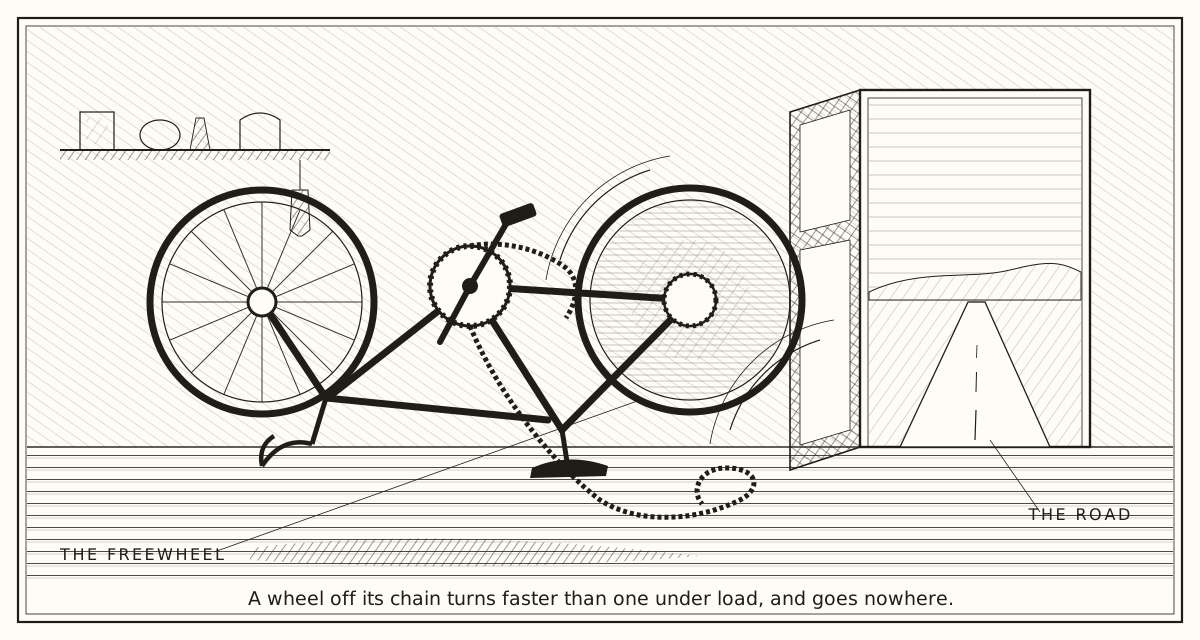
That the speed is a state and not a verdict. A racing mind feels like evidence that there is too much to do or that something is wrong with you, and it is usually neither. It is a brain that has been pushed into its emergency gear by caffeine, short sleep, open loops and a hormone that peaks before breakfast, and that stays there because nothing has told it to come down. The gear can be changed, and the levers that change it are plain: less stimulant, more sleep, hard movement, the list, the appointment, the ten minutes. None of them asks you to think more slowly on purpose, which cannot be done. They change the conditions, and the thinking slows on its own, the way a wheel does when the road comes back under it.
One email when a book ships. Nothing between.
One email when a book ships. Nothing between. Unsubscribe any time; never sold or shared.