Why does my mind wander so much — and is that a bad thing?
Published by Corso & Alexander · About David Luria
Your mind wanders so much because wandering is what a human brain does when nothing in front of it demands the whole of its attention. It is not a fault in you. In the largest study of the habit, which sampled the thoughts of 2,250 people at random moments through the day, minds were somewhere other than the task at hand about 47 percent of the time, and in every activity but one that share never fell below 30 percent. The drift is driven by a set of brain regions that switch on precisely when you are not concentrating on anything, and it does real work: rehearsing the future, sorting the past, turning over problems you have not solved. It becomes a problem in two cases only. The first is when the wandering keeps circling the same worry, which is a different thing with a different name. The second is when the task in front of you cannot afford the lapse. Most of the time, the honest answer to "why does my mind wander so much" is that it is doing what everybody's does, and you have started noticing.

The rest of this note is about the difference between the ordinary drift and the kind that costs you.
Is mind wandering normal?
Yes, and the numbers are larger than most people expect. In 2010 Matthew Killingsworth and Daniel Gilbert at Harvard published a short paper in Science called "A Wandering Mind Is an Unhappy Mind." They had built an iPhone app that interrupted volunteers at random times and asked three questions: what are you doing, what are you thinking about, and how do you feel. Across a quarter of a million answers, people reported that their minds were off the task 46.9 percent of the time. The share varied by activity, but not by much. The only activity that pulled the figure sharply down was sex, and even there people reported some wandering.
That is a single study of people who owned an iPhone in 2010 and chose to install a survey app, and should be held that lightly. But it lines up with a long line of laboratory work. Jonathan Smallwood and Jonathan Schooler, who have studied the phenomenon for two decades, reviewed the field in the Annual Review of Psychology in 2015 and put the typical laboratory figure at somewhere between a quarter and a half of the time, depending on how dull the task is. The dullness matters. Michael Kane and colleagues at the University of North Carolina at Greensboro sampled students through a week in 2007 and found that minds wandered most when the activity was boring, stressful or unchallenging, and least when people were doing something they liked and found demanding.
So the person searching "why does my mind wander so much" is almost never an outlier. They are someone who has started to watch a process that was always there. Counting your own lapses is alarming in the way counting your own blinks would be.
Why does my mind never stop thinking?
Because part of the brain never rests, and the part that runs when you are "doing nothing" is the part that produces thought. In 2001 Marcus Raichle and colleagues at Washington University in St. Louis published a paper in the Proceedings of the National Academy of Sciences describing what they called the brain's default mode. Scanning people lying quietly with no task, they found a set of regions along the midline of the brain that were more active at rest than during almost any task, and that went quiet the moment a demanding task began. Later work tied this default mode network to exactly the mental activities people report when their minds wander: remembering, imagining the future, thinking about other people, thinking about oneself.
The picture that has settled since is not one of a lazy brain drifting. It is one of two systems taking turns. When the outside world asks for attention, the task-focused networks rise and the default network falls. When the world stops asking, the exchange reverses, and the default network fills the space with self-generated thought. A mind that "never stops thinking" is a mind whose idle system is running normally.
That framing matters for what you do next. You cannot switch the default network off by willing it, any more than you can decide to stop digesting. What you can change is what it works on, how quickly you notice it has taken over, and whether the moment you noticed was one where the lapse mattered.
Is mind wandering bad?
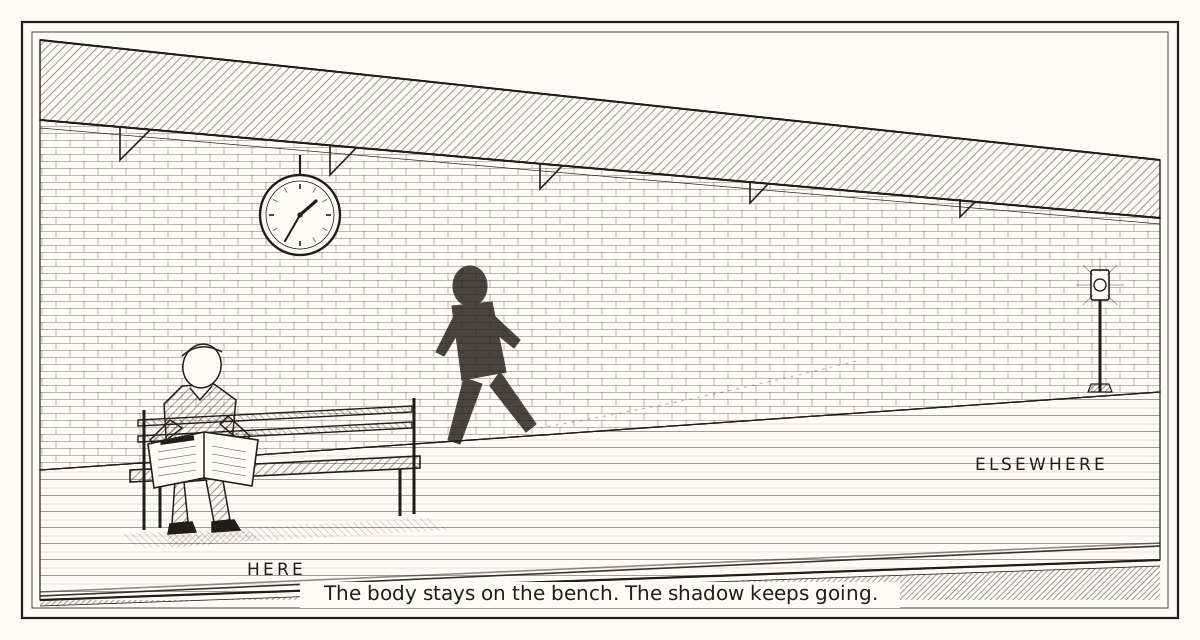
The Harvard study's title says yes, and the study's own data say something more careful. Killingsworth and Gilbert found that people were less happy when their minds were wandering than when they were not, even when they were wandering to pleasant topics, and that they were least happy when wandering to unpleasant ones. Their time-lag analysis, which looked at whether wandering at one moment predicted mood at the next, suggested that the wandering came first and the low mood followed, rather than the other way round. That is the basis for the famous title, and it is a real finding.
Three years later, a group at the University of Sheffield led by Giulia Poerio tested the reverse direction and found it too. In a 2013 paper in Consciousness and Cognition, they showed that sadness at one moment predicted more mind wandering at the next, and that the wandering that followed tended to be about the past and about oneself. Put the two studies together and the honest reading is a loop, not an arrow. A low mood sends the mind off, and a mind that has gone off, particularly toward what went wrong, brings the mood down further.
The word that separates the harmless from the harmful is rumination. Susan Nolen-Hoeksema at Yale spent her career on it, and her definition is precise: repetitively and passively focusing on the symptoms of distress and on their possible causes and consequences, without moving toward a solution. Her research, summarized in a 2008 review in Perspectives on Psychological Science, tied that habit to longer and deeper episodes of depression and to worse problem-solving. Rumination is mind wandering with the steering locked. The mind leaves the task, yes, but it goes to the same place every time and walks the same circuit when it gets there.
So the answer to "is mind wandering bad" is that the drifting itself is neutral, and what it costs depends on where it goes and whether it comes back. A mind that wanders to Saturday's plans and returns is doing something ordinary. A mind that wanders to the same argument, the same failure or the same fear, and returns only when something external drags it, is doing the thing the clinical literature worries about. If your wandering has a fixed address, that is the part to attend to, and the earlier note on what to do when your mind races at 2 a.m. is about the hour when that address tends to be visited.
Is mind wandering good?
Sometimes, and in ways that are measurable. In 2012 Benjamin Baird, working in Schooler's laboratory at the University of California, Santa Barbara, published a study in Psychological Science under the title "Inspired by Distraction." Participants were given a creativity task, the kind where you list unusual uses for an ordinary object, then had a break before a second attempt. Some spent the break on a demanding task, some on an undemanding one that let the mind drift, some rested, and some had no break. The group that spent twelve minutes on the undemanding task, the one that let the mind wander, improved the most on problems they had already seen. They did not do better on new problems. The wandering had not made them more creative in general. It had let the unfinished problem keep running in the background, and the answer had surfaced.
That fits what people report when asked what they are thinking about when their minds wander. Most of it is about the future: plans, rehearsals, what to say to whom. Smallwood and Schooler's review calls this prospective bias, and it is one of the strongest findings in the field. A wandering mind is often a planning mind, running scenarios it will need later. There is also evidence, from Paul Seli and colleagues at the University of Waterloo, that some of it is chosen. In a 2016 paper in Trends in Cognitive Sciences they argued that deliberate mind wandering, letting the mind go because the task allows it, and spontaneous mind wandering, being pulled off the task against your intention, are different things with different consequences. The deliberate kind is what a person does on a long walk. The spontaneous kind is what happens in the meeting that matters.
Nobody has shown that mind wandering makes you more creative as a trait, and the popular versions of Baird's study claim more than it did. What it showed is narrow and useful: a break that lets the mind drift can help with a problem you have already loaded. It is not an argument for drifting through the problem itself.
Why does my mind wander when I read?
Because reading is the activity in which the lapse is easiest to catch, and one of the few in which you can prove to yourself that it happened. Everybody has reached the bottom of a page and realized that nothing on it arrived. Schooler and colleagues studied exactly this in the early 2000s, interrupting readers at random to ask whether they were still on the text, and found that people were frequently caught zoning out without having noticed it themselves. The eyes keep tracking the lines out of habit after comprehension has stopped, which is why you can turn a page and not know what was on it.
Reading is vulnerable for two reasons. It is usually quiet, with nothing in the environment to pull you back. And most reading is undemanding line by line, even when the book as a whole is hard, so the task-focused system relaxes and the default network takes the slack. The same applies to a lecture, a sermon, a long meeting and a highway at night. What the situations share is low moment-to-moment demand and no interruption when the mind goes. The fix, where a fix exists, is usually in the task rather than in the reader: shorter stretches, a pencil in the hand, a question to answer at the end of the section. A reader who has to produce something from the page drifts less than one who only has to receive it.
Why does my mind wander during meditation — or when I pray?
Because meditation and prayer are the two activities in which a person sits still, removes the world's distractions on purpose, and then watches the mind. Nothing about either practice causes the wandering. They reveal it. The default network, given silence and a still body, does what it does. What is new is that for once someone is watching.
The laboratory has looked closely at this. Wendy Hasenkamp and colleagues at Emory University scanned experienced meditators in 2012, in a study published in NeuroImage, and described a four-part cycle that repeated throughout a session: the mind focused, the mind wandered, the meditator noticed, the meditator returned. Each phase had its own pattern of brain activity. Noticing, in particular, lit up the regions associated with detecting that something has changed, and the return engaged the regions associated with control. The whole point of the practice, on this reading, is the repetition of that cycle. The wandering is not the failure of the meditation. It is the material the meditation works on.
That reframing has practical weight, because the commonest reason people abandon meditation is that they believe they are bad at it, and the evidence they cite is that their mind kept wandering. Everyone's does. A 2011 study by Judson Brewer and colleagues at Yale, in the Proceedings of the National Academy of Sciences, found that experienced meditators showed less default-network activity during meditation than novices, which suggests the practice does change something over years. It does not suggest that the wandering stops. People who have meditated for decades report that the mind still leaves. They notice sooner, and the return costs less. That is the whole of the skill, and a beginner who expects anything more has been sold something the research does not support.
The same applies to prayer, whatever the tradition. The complaint is as old as the writing about prayer, and the traditions, read plainly, say what the neuroscience says: notice, return, and do not add a second layer of distress about having wandered.
Is mind wandering a symptom of ADHD?
It can be, and the distinction the research draws is between the kind you can steer and the kind you cannot. Seli and colleagues published a study in 2015 in Psychonomic Bulletin & Review separating spontaneous from deliberate mind wandering in a large sample of adults and asking them about ADHD symptoms. Spontaneous wandering, the kind that pulls attention away against intention, was associated with ADHD symptoms. Deliberate wandering, the kind a person permits, was not. A 2018 review by Natali Bozhilova and colleagues at King's College London, in Neuroscience and Biobehavioral Reviews, went further and proposed that excessive, uncontrolled mind wandering might be a core feature of adult ADHD, one that explains several of the everyday difficulties better than the older list of symptoms does.
What this does not mean is that a wandering mind is evidence of ADHD. Nearly half of everybody's waking thought is off-task; a diagnosis rests on a pattern that is persistent, present since childhood, and impairing across settings, and on an assessment by someone qualified to make it. The useful question to ask yourself is not "does my mind wander" but "can I bring it back when the situation requires it, and does it cost me at work, in relationships or in safety more than it costs the people around me." If the honest answer is that it does, and has for a long time, that is a reason to talk to a clinician. It is not a reason to self-diagnose from a blog post.
How to stop my mind from wandering
You do not stop it, and the research is clear that trying to is the wrong target. What you can do is change three things: how fast you notice, what the drift tends to feed on, and how much the task in front of you exposes you to the lapse.
On noticing, the best-controlled evidence is a small study that should be read for what it is. In 2013 Michael Mrazek and colleagues at UC Santa Barbara, in Psychological Science, randomly assigned 48 undergraduates to two weeks of either a mindfulness class or a nutrition class. The mindfulness group improved on a reading comprehension test drawn from the GRE and on a measure of working memory, and reported less mind wandering during the tests. The nutrition group showed none of those changes. Forty-eight students, two weeks, one campus: a promising result, not a settled one, and the wider literature on mindfulness training is mixed on how large and lasting its effects are. But the mechanism it points to is the one Hasenkamp's meditators were practicing. Training the act of noticing shortens the gap between the moment the mind leaves and the moment you know it has.
On what the drift feeds on, the practical move is the one the rumination research supports: when you catch the mind at its fixed address, do something that changes the question rather than arguing with the thought. Nolen-Hoeksema's work found that people who broke a ruminative spell with a brief absorbing activity, even a mundane one, solved problems better afterward than those who stayed in it. Writing the worry down in one line and setting a time to deal with it moves it from the default network's endless loop into a plan, which is the kind of thought that ends. If the fixed address is a self-judgment, there is fair evidence that a few minutes writing about something you value works better than repeating a slogan at yourself, and the earlier note on whether affirmations actually work sets out what that evidence does and does not show.
On the task, design for the lapse rather than against it. Break long passive stretches into short active ones. Give yourself something to produce at the end of each section, a note, a summary, a decision. Take the phone out of the room when the work is reading or writing; every glance is a licensed lapse the default network will extend. Where the cost of a lapse is high, on a highway, in a hospital, at a machine, the safeguards belong in the environment: an alarm, a checklist, a second person. No amount of self-discipline removes the 47 percent. It only moves it to the moments that can afford it.
What is the one thing to hold on to?
That the wandering is the baseline, and the skill is the return. Half of waking thought goes somewhere else in everyone, and the studies that found this were not studying patients. They were studying people. If it goes to plans and pleasant nowhere and comes back on its own, leave it be; it is doing its work. If it goes to the same wound every time and stays there, that is rumination, and there are things that help, starting with noticing that it has happened. Notice, return, and do not punish yourself for the leaving. You will be doing it again in a few minutes, and so will everyone else in the room.
One email when a book ships. Nothing between.
One email when a book ships. Nothing between. Unsubscribe any time; never sold or shared.