How do I stop worrying about my adult children — and is it normal to worry about grown kids this much?
Published by Corso & Alexander · About David Luria
You stop worrying about your adult children by changing what the worry is allowed to do, not by trying to feel less of it. The feeling is the oldest part of being a parent and does not retire when the child leaves; the research finds that almost no parent of grown children stops, and that the parents who worry a moderate amount and say so have the warmest relationships of all. What damages the relationship, and the parent, is worry that has turned into a job: checking, advising, funding, rescuing, lying awake over a thirty-one-year-old's choices as if they were still yours to make. The work is to let the worry fire, give it one honest outlet, and return to a life of your own. That is a skill with steps, and this note sets them out.

Is it normal to worry about adult children?
Yes. The clearest study was run by Elizabeth Hay at the University of Florida with Karen Fingerman, then at Purdue, and Eva Lefkowitz at Penn State, published in Personal Relationships in 2007. They interviewed 213 families in the Philadelphia area, each a grown son or daughter aged twenty-two to forty-nine and both of that child's parents, aged forty to eighty-four. Very few people in any of the three seats reported not worrying about the others. The children mostly worried about their parents' health; about seven in ten named it first. The parents' worries were wider: a child's health, money, marriage, a job that looked unsafe, the strain of children and work at once. Most were specific to the child in front of them, not a sense that the world is dangerous.
The finding that matters is what the worry did to the relationship, and it ran in two directions. Up to a point, being worried about felt like being loved. Parents and children alike rated the relationship more warmly when the other person worried about them and said so; Hay called worry "socially and emotionally supportive," a sign of investment. Past that point the line bent the other way. When the worry was voiced too often, the person receiving it rated the relationship worse; the authors' reading was that too much of it is a vote of no confidence in the other adult's ability to run their own life. A grown child who is worried about feels held. A grown child who is worried at feels managed.
A companion paper from the same families, in the International Journal of Aging and Human Development in 2008, added one detail worth keeping. Parents whose chief worry was their child's finances reported poorer relationships with that child than parents whose chief worry was something else, such as safety. Money is the worry most likely to come with instructions attached.
Why do I worry about my adult son so much?
Because the equipment that made you a competent parent of a two-year-old has no off switch, and because you are more tied to how your children's lives go than you may want to admit.
The equipment first. The earlier note on why you worry so much sets out the general case: the alarm in every human head is tuned to fire early and often, since for most of our history a false alarm cost little and a missed one cost everything. Parenthood turns that dial further. For two decades the alarm was correct to fire at a silence, a cough, a car that was late, because you were the one who had to act. It learned that a quiet phone means something is wrong. Then the child moved out, and the alarm kept its training.
Now the tie. Karen Fingerman, by then at the University of Texas at Austin, with Yen-Pi Cheng, Kira Birditt and Steven Zarit, interviewed 633 middle-aged parents about every one of their grown children, 1,251 children in all, and reported the results in the Journals of Gerontology: Psychological Sciences in 2011 under a title that gives away the finding: "Only as Happy as the Least Happy Child." The researchers expected a child doing well to offset a child doing badly. It did not. Several successful children lifted a parent's well-being, but a single child with one serious problem, a divorce, a lost job, an illness, was enough on its own to raise the parent's depressive symptoms and worry, with no credit from the ones who were fine. Fingerman offered several reasons: parents feel their children's pain, feel exposed when a struggling child's relationship with them sours, and sometimes carry heavy demands from that child. The last reason is the one most parents recognize: "Parents have a distinct investment in grown children reflecting decades of child-rearing." Their lives read, to you, as a verdict on yours.
Erin Greenfield and Nadine Marks had found the same pattern in a national sample of midlife adults, in the Journal of Marriage and Family in 2006: parents whose adult children were in difficulty reported lower well-being than parents whose children were not. The verdict feeling has numbers now. In a Pew Research Center survey of 3,017 American parents of children aged eighteen to thirty-four, published in January 2024, seventy-one percent said their children's successes and failures reflected on their parenting. That belief does much of the worrying, not the child.
If the question is specifically about a son: the Hay study found no difference in how much parents worried about sons and daughters, only in what about.
When do parents stop worrying about their kids?
They don't, and the timetable has moved.
The parents in the Hay study ran up to eighty-four and were still at it. What changes is not the presence of worry but its form. Early on, worry has an outlet: you can act. Later it has none, which is when it goes wrong, because a feeling built to drive action, with no action available, turns into checking and talking.
The timetable matters because adulthood arrives later than it did. Jeffrey Arnett, the psychologist who in a 2000 paper in American Psychologist named the stretch from the late teens to the late twenties "emerging adulthood," argued that it had become a distinct stage in which the old markers of being grown, a settled job, a marriage, a child, are postponed rather than skipped. The Census Bureau puts the median age at first marriage at around thirty for men and twenty-eight for women, up from the early twenties in the 1950s. A parent whose own parents stopped having a say at twenty-two now has a child of twenty-nine who still asks for advice and still texts a few times a week; in Pew's survey seventy-three percent of parents reported that much contact, and fifty-nine percent had given money in the past year. The longer runway is not a failure, yours or theirs. But the years in which you are involved and worried, and in which the involvement is partly appropriate, run further than they did a generation ago, and the point at which worry should hand over to trust is harder to see.
Is this anxiety about adult children, or is it love?
It is both, and the test for which is in charge is simple: what does the worry make you do?
Love worries and then does one proportionate thing. It sends the message, makes the offer, asks once, and gets on with the day, accepting whatever answer comes, including silence. Anxiety worries and then does something to make the worry stop: a second message when the first is not answered, a call to the roommate, a look at the location app, an unasked-for transfer of money, an evening's talk with your spouse that is really a trial of the child in absentia. The first serves the child. The second serves the feeling.
The location app deserves its own line. Pew found that a quarter of parents of eighteen-to-thirty-four-year-olds track their child's whereabouts by phone at least occasionally; for parents of eighteen-to-twenty-four-year-olds the figure is forty-two percent. Some of those arrangements are mutual and benign. Many are a worry that has found a button. Checking relieves the alarm for a minute and teaches it that relief requires checking, so the next silence rings louder. The earlier note on why you overthink everything describes the same loop in the single mind. Here it runs through another adult, who can feel it.
The second test is about the child. Fingerman and colleagues, in a 2012 paper in the Journal of Marriage and Family called "Helicopter Parents and Landing Pad Kids," looked at intense support, several kinds of help given several times a week, among 399 parents and nearly 600 of their children aged eighteen to thirty-three. Nearly thirty percent of parents were giving it to at least one child. The children who received it were not worse off; they reported clearer goals and higher life satisfaction than their less-helped peers, though one in six said they were getting more than they wanted. The parents were a different story. Their well-being did not track how much they gave; it tracked how much they believed the child still needed. Parents who thought their children needed more support than they could give reported lower life satisfaction. The help itself does little harm to a grown child who wants it. The running estimate of their neediness, kept in your head, is what harms you.
Worrying about young adult children: what parents actually get wrong
Mostly, they get the aim wrong, not the amount.
The Hay finding, that moderate worry warms the relationship and heavy worry chills it, reads like a dose instruction: worry less. But the variable in that study was expression, how much the worry was voiced and how that landed. A parent can carry a great deal of worry, express it twice a year in the right words, and be loved for it. A parent can carry a modest amount, express it every Sunday in the wrong words, and be avoided.
The wrong words put the worry's burden on the child. "I just worry about you" sounds like love and lands as a request: make this feeling of mine go away by living differently, or by reporting more. Over months it teaches a grown child that contact with you costs something, and the rational response to a cost is to reduce it, which produces the silence that makes you worry more. The finances finding sits inside this. A parent worried about money nearly always has a view about what the child should do with it, and a view about money is the fastest way to make an adult feel like a child again.
The second mistake is to treat the worry as information about the child. Far more often it is information about you, about the alarm's training and the verdict belief. A 2020 study by Lucas LaFreniere and Michelle Newman in Behavior Therapy, in which people with generalized anxiety wrote down their worries and later recorded what happened, found that about nine in ten of the feared events never occurred, and most of the rest went better than feared. Parents of adults have a long record to check this against. Count the catastrophes you were certain of in the last five years, then count how many arrived.
What does worrying about grown children cost?
It costs the relationship first, then the parent's health, then, quietly, the child's standing as an adult in your eyes.
The relationship cost is the Hay curve: past the warm middle, every extra voiced worry subtracts. The health cost is what the "least happy child" research measures, depressive symptoms that rise with each struggling child. A body kept braced for a threat it cannot act on does not get to stand down, and decades of it is a long time to stay braced.
The third cost is the hardest to see because someone else pays it. Every unasked-for rescue tells a grown child, kindly, that you do not think they can manage. The child who is always caught does not learn what they can carry, or what you believe they can carry, and children of any age read that closely. There is also your own life. Erik Erikson described middle adulthood as a choice between generativity, pouring yourself into the next generation and the wider world, and stagnation. Worry about adult children masquerades as generativity. It feels like giving. Much of the time it is standing at a gate the child went through years ago.
How to stop stressing about adult children
Not by caring less. By routing the care. These are habits, not cures, and each is small enough to try this week.
Let the alarm ring, then decide what it is for. When the worry arrives, before you act, ask one question: is there something I can do today that this person has not refused? If there is, do it once. If there is not, the worry has no job, and you treat it as weather. This is the productive-versus-unproductive test Robert Leahy set out in The Worry Cure, applied to someone else's life, where the answer is "nothing" more often than in your own.
One message, then wait. Send the text you want to send. Do not send the second one. A grown child's unanswered message is, almost always, a grown child who is busy. The alarm will say otherwise. You need not believe it, and each time you wait and the reply arrives, the alarm learns a little.
Say the worry once, in the right words, and give it back. The Hay study is a permission slip: moderate, voiced worry is received as love. So say it, plainly and rarely: "I worry about you sometimes. That is mine to carry, not yours. I trust you." The last sentence changes the relationship, and it is the one worried parents leave out. Then ask for no report.
Make the offer open-ended and stop steering. "If you ever want a second pair of eyes on the lease, I am here" is help. "Have you read the lease?" is supervision. The difference is who decides whether help happens. Grown children who can decline your help take more of it, over time.
Audit the money, and close the app. If your chief worry is your child's finances, the 2008 paper says that worry is the one most likely to be souring the relationship. Decide once what you will and will not fund, say it in one conversation, and stop reviewing their spending in your head. Help that comes with monitoring is not experienced as help. The same goes for the location app: if it is mutual and you both like it, keep it; if it is a button you press when the alarm rings, it is feeding the alarm. Remove it for a month and see.
Put the worry on paper, then check the record. Write down the three outcomes you most fear for each child, and the date. Look at the page in six months. A page that has been wrong twice is easier to doubt the third time.
Build the life the worry has been standing in for. The parents in the Fingerman studies who did best were not the ones who cared least; they were the ones whose well-being did not hang on a running estimate of their children's need. That requires somewhere else for the attention to go: work, friends, a craft, the long-postponed thing. A parent with a full life has less of it on the line each time the phone is quiet.
Know when it is a crisis and not a worry. None of this applies to a child in real danger: a serious illness, an addiction, a violent partner, a mind that is not well. There the proportionate action is large, and you take it. This note is for the ordinary case, which is most cases, where the child is fine and you are not. If you cannot tell which case you are in, take that question to a professional; doing so is itself the proportionate action.
What is the one thing to hold on to?
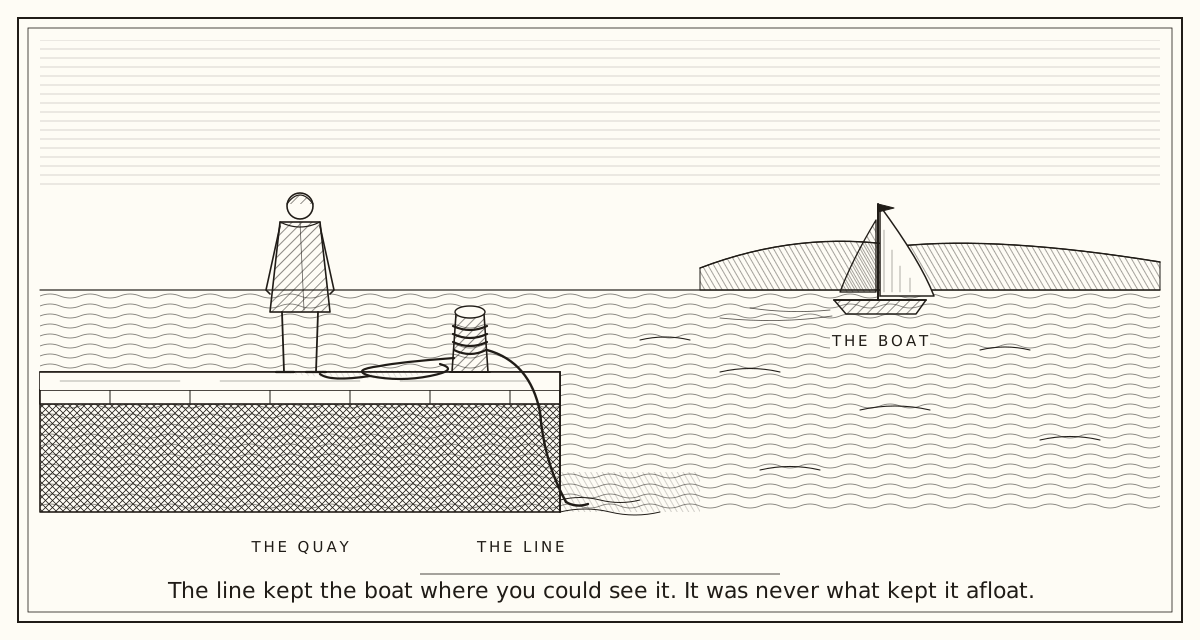
That you were never the thing holding the boat up. The mooring line keeps a boat where you can see it. Cast off, the boat floats on what it floated on at the quay, which was never the line. You worry about your adult children because you spent two decades as the person who had to act, and the alarm that made you good at it does not know the job has changed. It is normal, and in moderation, said aloud and rarely, it is received as love. The harm begins when the worry becomes a second message, a review of the bank statement, a glance at the map. So let it ring. Say it once. Make the offer and leave it open. Then step back from the quay and look at your own water for a while. The people on the platform in Chicago in January 1943 said goodbye and went home, and the train left when the timetable said it would, as it always does.
One email when a book ships. Nothing between.
One email when a book ships. Nothing between. Unsubscribe any time; never sold or shared.