Why won't my siblings help with our elderly parents — and how do I get them to?
Published by Corso & Alexander · About David Luria
The people and first-person scenes in this article are fictional/composite examples, created to illustrate the issues. They are not the author’s personal history. The scenes illustrate caregiving situations; they are not evidence of clinical or legal outcomes.
Siblings don't help with elderly parents, most of the time, because the work got divided by fairness instead of by life, and a split that looks even on paper falls apart the first week it meets three real calendars. Splitting your mother into equal thirds guarantees that somebody feels cheated and somebody feels accused, and the one who feels cheated is usually the one reading this. You get them to help by changing what you ask for: not an equal share, but the share each of them actually has to give, whether that is money, time, phone calls, or the drive across town. And you get the schedule out of your own head and onto something all of you can see, because the fights start in the gap where a plan should have been. The rest of this is how I learned it, and I learned it by being the one who behaved badly.

When a sibling doesn't help with an aging parent: the Sunday I struck the match
The pass came to my daughter with the field wide open in front of her, and I wasn't there to see it.
My sister was. She had texted the photo that morning, my niece and my daughter on the same summer-league sideline. I was at my desk. Three hours from a deadline I had moved twice already, doing the work that pays for all of this.
Then the group chat lit up. Three of us in there, me and my two sisters, the chat we started for exactly this. The command center for a mother none of us lives close enough to. My sister had typed it fast. Mom's stranded at the clinic, ride fell through, I'm at the game, can anyone grab her.
I read it twice, and the heat climbed up my neck.
Must be nice to be at a game, I typed. And sent it. And knew, before my thumb was off the screen, that I had blown it.
That text was not about the ride. The ride was solvable in four minutes with an app. It was about a ledger I had kept for a year without telling anyone, with every call and every form and every drive to the clinic in my column and almost nothing in theirs. My sister was not the fire. The fire was already lit: Sophia alone on a clinic bench, a deadline I had broken twice, three calendars with no room left in them for anyone to be a person. My sister was just the one standing closest when I struck the match.
Why siblings don't help with elderly parents
Siblings don't help for four reasons I have seen up close, and only one of them is the reason you think.
They don't see it. Whoever lives closest, or answered the phone first, becomes the one who knows. Your sister two states away knows that Mom "sounds fine on the phone," because Mom sounds fine on the phone; that is the skill dementia leaves alone the longest. Your sister is not refusing to carry something. She cannot see the thing you are carrying. From where she stands, you have it handled, at a cost she has never been shown.
The split was never designed. Nobody divided this. It got divided by accident, by geography, by who had a spare afternoon in the first bad month, and then the accident hardened into a job. The one doing the most never agreed to do the most. The ones doing less never agreed to do less. Now there is a system nobody built and everybody resents.
They are carrying something you don't know about. A marriage in trouble. A job quietly ending. A kid who is not okay. They would not tell you, because telling you would sound like an excuse. When my sister said she was at the game, I heard leisure. What I did not hear was that it was the first Sunday in a month she had made it to anything of her daughter's, because the other Sundays had gone to our mother.
A few siblings really are absent. Not hiding something. Not unable to see. Just gone, by choice, and comfortable being gone. If you have one, you know it, and no shared calendar will change it. But before you file a sibling there, check whether the first three fit. I filed mine there for a year and I was wrong.
My siblings don't help with aging parents — or do they, just not the way I count?
Here is what my ledger had left out, when I finally looked.
My older sister did not drive Mom to the clinic. She lived too far. What she did was call every evening at six, for twenty minutes, and had for two years, which meant that on the nights I was too tired to call, someone had. She also paid for the aide two afternoons a week and had never once mentioned it.
My younger sister, the one at the game, was the one Mom actually told things to. When the stove got left on, I found out from Jenny, because Mom had told Jenny and not me. That is a job. Someone has to be the one she is not embarrassed in front of, and it could never be the one who took the keys.
I was doing the visible work. The forms, the drives, the doctor. But I had been counting only the things I could see myself doing, so my column was full and theirs was empty, and the ledger was a lie I had written in my own hand.
If you keep a ledger like that, and most of us do, try one thing before the next fight. Write down what each sibling actually does, including the things that are not chores. Who does she call when she is scared. Who pays for what, without being asked. Who is the one she does not lie to about the falls. You will probably still be doing the most. But "my siblings don't help" may not be quite the sentence you thought it was.
Sister will not help with elderly mother, brother not helping either: the two silences
There are two kinds of sibling silence, and they need different things from you.
The first silence is the one you built. You never asked. Not really. You asked once, early, in a general way, got a general answer, and then stopped asking and started resenting. I did this. It felt more dignified than asking, and it was useless, because a request I never made could never be refused. If your sister will not help with your mother, ask first whether she has ever been asked for one specific thing with a day attached. "Can you take Tuesdays" is a question. "It would be nice if people helped" is a mood.
The second silence is theirs. You asked, specifically, and got nothing, or a yes that never turned into a Tuesday. This one is real, and no system fixes it. Every hour I spent furious at the sibling who would not come was an hour I did not have for the mother who was still here. At some point, and only you know when, the honest move is to stop asking the one who will not answer and build the plan around the ones who will. That is not forgiveness. It is arithmetic, and it is the arithmetic that keeps you standing.
Neither silence gets handled in the group chat. The chat is where logistics live. The moment it becomes the place the family argues about who loves her more, nobody will open it.
How to get siblings to help with elderly parents
You cannot make anyone help. You can make helping possible, specific, and visible, and that turns out to be most of the battle.
Divide the load by life, not by fairness. It will never be even, because your lives are not even. One of you has money and no time; one has time and no money; one lives forty minutes away and one lives four states. Split it by what each of you actually has to give: money, time, phone calls, the drive across town, being the one she confides in. Different contributions are not unequal love. I had to say that sentence to myself about thirty times before I believed it.
Ask for a job, not for help. "Help" is a word people agree to and never do, because it has no edges. A job has edges. The pharmacy calls are yours. Tuesdays are yours. When my older sister took over the insurance company, permanently, the relief was out of proportion to the hours.
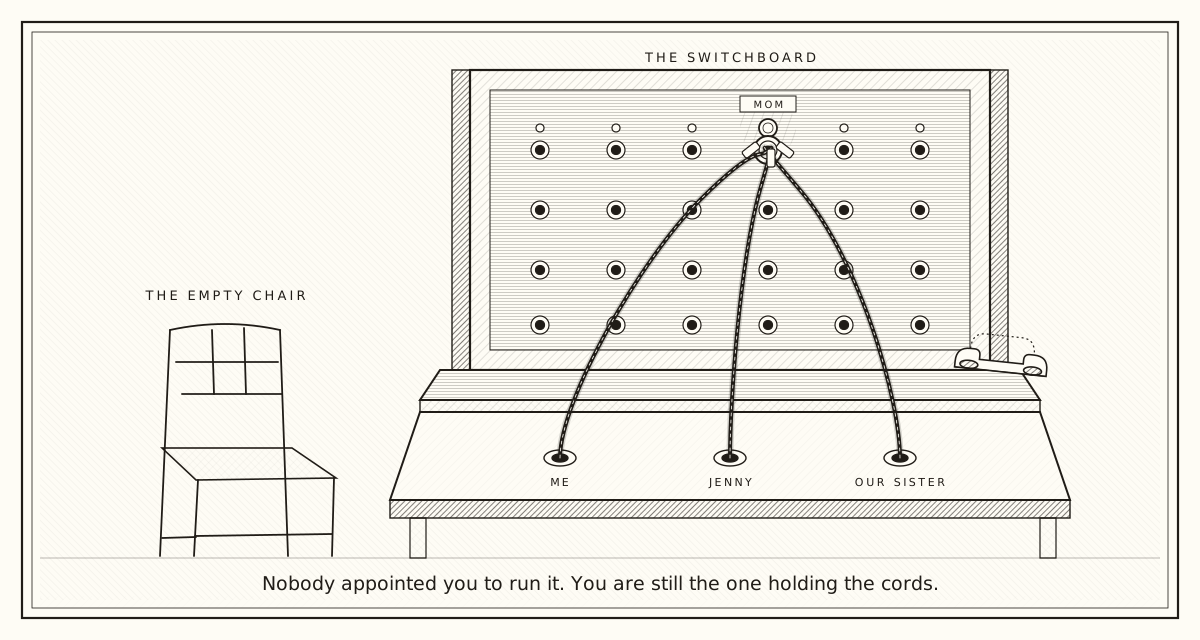
Get the switchboard out of your own head. You became the coordinator by accident, and holding three families' schedules in your memory is its own second job. Put it somewhere everyone can see: a shared calendar, a standing check-in, one recurring plan for who has her when. The goal is not a perfect system. It is that the next stranded afternoon has a plan behind it instead of a scramble and a spark.
Build a backup that is not a person. The ride that fell through became a fight because the only backup was a sibling. A rideshare account on her phone, or on yours so you can send a car to her, makes a fallen-through ride a four-minute problem instead of a family incident.
Make the invisible work visible, including yours. Not as a bill. As a list. Once a month, say what happened: the two clinic visits, the form, the night she did not know what year it was. So the sister two states away can finally see what you are carrying, and so you can see what she is.
How to talk to siblings about caring for elderly parents
The conversation that worked in my family was not the one I rehearsed. The one I rehearsed had a lot of my hours in it. A speech about how much you do is a request for applause, and siblings do not applaud each other.
What worked was three sentences, on a Sunday call, after the apology had been made and accepted.
"She's getting worse, and I can't be the whole plan anymore." That is the hard one, because it admits something the one doing the most does not like to admit. I am not failing. I am also not enough. Both are true.
"Here's what has to happen every week." Then the list, short and boring: the pharmacy, the six o'clock call, the doctor every six weeks, somebody in the house twice a week, somebody who can pay the aide. No adjectives. No "and I've been doing all of this," even though I had. The list speaks for itself if you let it.
"What can each of us actually take?" Not should. Can. Then silence, which is the part I am worst at. My younger sister took the six o'clock calls three nights a week, which I would never have thought to ask, because I thought of the calls as nothing. My older sister took every call with every institution, because she does not raise her voice at people on hold. I kept the drives and the doctor.
It was not even. It was never going to be even. It was, for the first time, a plan.
Have that call after the emergency, never during. And if a sibling will not come, have it anyway with the ones who will. Waiting for the whole family to show up is a way of never starting.
If the guilt of asking is what stops you, if some part of you thinks needing help means failing her, I wrote about that guilt separately, and the short version is that you were never assigned the whole column.
Resentment towards siblings caring for parents — what it turns you into
Now the part nobody puts in the checklists.
It looks like a fight about who does more. It isn't, not really. It's a fight about being outnumbered by your own love.
Every person you're responsible for is someone you would run into traffic for. That's the trap. If you loved them less, this would be easy. You'd triage. You'd let something drop. But you can't let your mother sit on that bench, and you can't let your sister give up one more Sunday, and there is only one of you. The math doesn't work because the love doesn't subtract.
So you are grieving the family that used to gather without logistics. The holidays that just happened. The phone calls that were only phone calls. The sisters who were your sisters before they were your co-managers of a shared and shrinking mother. That kind of grief has a name, and it is not your sister's fault, and it is not yours.
But here is the loss that costs the most. The resentment is turning you into someone you don't like. Someone who types five ugly words he would never say to his sister's face, to a sister who was doing nothing wrong, who was at the field precisely so that one of you could be a person that day. You are losing your own good behavior, one bad afternoon at a time. And the shame of that lands on top of everything else, which is exactly when you are most likely to do it again.
I have no fix for that, only a warning. Resentment toward siblings does not stay pointed at siblings. It leaks. It gets into how you speak to your mother on the hard days. It gets into your marriage, which did not sign up for a switchboard either. The calendar and the split by life are not really about efficiency. They give the resentment fewer places to catch fire, so you can still stand to be around yourself when this is over.
What it cost when it went wrong
The text did not cost the ride. It cost more than that.
My mother sat on that bench for an hour and forty minutes. Not because nobody would go. Because the chat had turned into something none of us wanted to open, and the twenty minutes it took my older sister to leave a meeting and drive to the clinic were spent, by all three of us, staring at five words instead of solving a problem a car could have solved in four.
It cost my younger sister a Sunday she had already given up too many of. She left the game at halftime. Not because I asked; I had only sneered. She could not sit there with that text on her phone, and so the one afternoon that was hers got taken too, by me, for nothing.
It cost six weeks of a chat too polite to be useful, and coordination got worse, not better, because the thing we were avoiding was each other, and the plan lived in each other.
And it cost me a version of myself I had thought I was. The reliable one, who did the forms, was also the one who would aim something cruel at the sister who least deserved it. Both were me. Nobody else in the family had to carry that discovery. I did.
None of that was the arithmetic's fault. The day was impossible. But I was the one who struck the match, and no arithmetic makes that part someone else's to carry.
The landing
My mother got home that day. One of my sisters left work early and got her, and by evening the group chat was logistics again, as if nothing had flared.
I called the sister I had snapped at that night. I kept the apology short, the way I had been told to and had never once managed: I was awful today, you didn't deserve it, you were right to be at the game. And then, because she is better at this than I am, she said the thing that undid me. "I know. I almost sent you the same text last week."
She forgave me before I had finished asking.
That is the part I want you to have, and the part I want you to be careful with. Your siblings will very likely forgive you faster than you will forgive yourself. You will be the one replaying the five words at 2 a.m., long after your sister has set them down. Let her forgiveness be real. Take it. But do not wait for it to close the wound all the way, because that last stitch was never hers to make. It is yours. It comes later, and it comes harder.
Your siblings are probably not the villains your ledger says they are, and you are probably not the saint. Ask for a job, not for help. Divide it by what each of you has, because fair was never on offer. Get the plan onto a screen you all can see. And when you lose your temper, some tired, cornered Sunday, apologize the same day and keep it short.
You will be the villain in the group chat once. That is not a family failing. That is what love under pressure does to decent people. Catch your breath. The forgiving, the kind you owe yourself, will keep.
This is the idea at the center of one chapter of When the Keys Go, the first Tempered Press book, out now on Kindle. The second, Managing Mom's Money With Love, is out now on Amazon. One email when a book ships. Nothing between.
The books
- When the Keys GoA 2 a.m. guide to caring for your aging parents — and forgiving yourself. out now on Kindle.Buy on Amazon now
- Managing Mom's Money With LoveA field guide to your aging parents' affairs — and the institutions that keep saying no. out now on Amazon.Buy on Amazon now
One email when a book ships. Nothing between. Unsubscribe any time; never sold or shared.