Why do I feel so guilty caring for my mother with dementia — and how do I deal with caregiver guilt?
Published by Corso & Alexander · About David Luria
The people and first-person scenes in this article are fictional/composite examples, created to illustrate the issues. They are not the author’s personal history. The scenes illustrate caregiving situations; they are not evidence of clinical or legal outcomes.
Caregiver guilt in dementia is grief that has nowhere to go, so it turns on the nearest person, and the nearest person is you. Your mother is here and not here. Nobody died, so there is no funeral, no week off, no word for what you are, and the sorrow has to land somewhere. It lands on the ledger: the visit you cut short, the sharp word at the sink, the afternoon you were relieved when she slept. The guilt feels like evidence that you are failing her. It is not. It is what love does when the person it is aimed at is slipping and nobody is to blame. You deal with it by naming it as grief, by closing the ledger instead of settling it, and by keeping the one part that was ever yours to keep. That is the whole answer. The rest of this is how I learned it, mostly by doing it wrong.

What is caregiver guilt: the night I counted
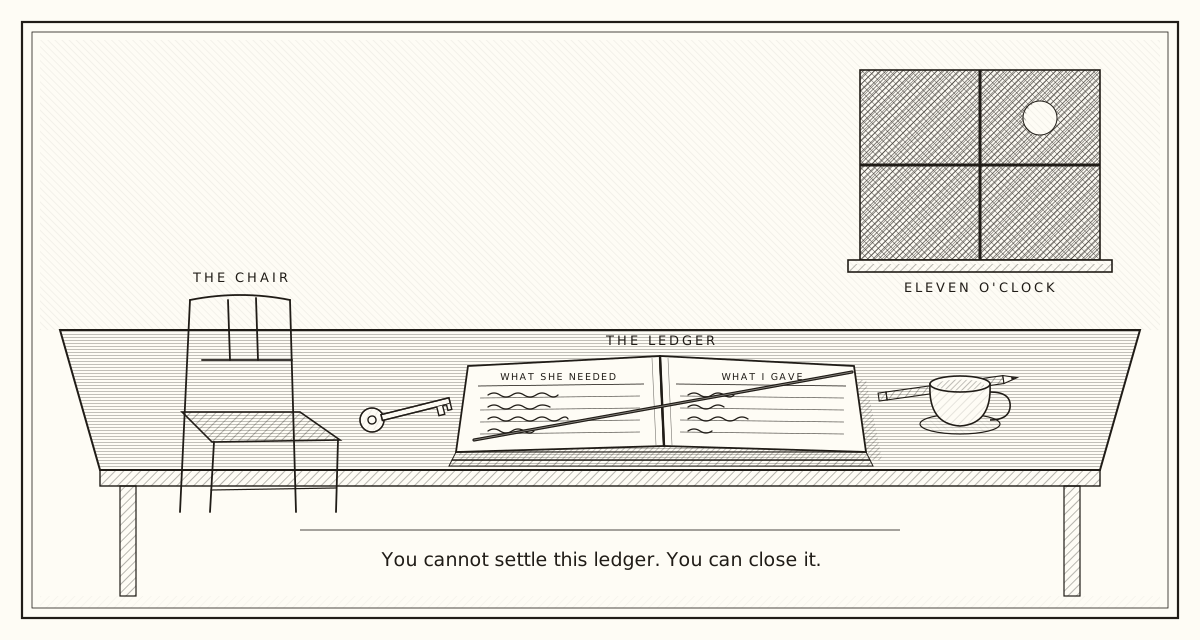
I found out I had been keeping a ledger the night I caught myself doing the arithmetic out loud, after eleven. Sophia, my mother, had asked me the same question about the thermostat nine times between dinner and bed, and on the ninth I answered in a voice I would not have used on a stranger. She looked at me the way you look at someone who has just been rude in a language you do not speak. Then she asked again. I said good night, went down to the kitchen, and sat with a cup of tea I did not drink, and I began to count. Two visits missed last week. A call I let ring. The word I said at the sink. The Saturday I spent on my own couch while my sister Jenny drove up. The afternoon, three months back, when she slept for four hours and I felt something I could only call relief, and I have been paying for that feeling ever since.
That is caregiver guilt. It is not a mood. It is a set of books, kept without meaning to, in two columns: what she needs and what you gave. You never write down the column that would balance it, which is what any human being can carry. So the books never balance, and you read the gap as a verdict on your character.
If you have sat at a table like that, doing math you never agreed to do, you already know the worst part. It is not that the number is bad. It is that you keep coming back to check it.
Why do caregivers feel guilty?
Caregivers feel guilty because guilt is what grief becomes when it is not allowed to be grief.
Family therapist Pauline Boss named the thing underneath this. She called it ambiguous loss: the person is physically present and psychologically gone, or gone in pieces, and the not-knowing has no end date. A death gives grief a shape. There is a day, a room full of people, a casserole on the porch, permission to fall apart. Dementia gives you none of that. Your mother is at the table. She is in the chair. That is not the same as being here, and every part of you knows it, and there is no ceremony that lets you say so.
So the sorrow goes looking for a place to stand, and it finds fault. Blame is just unfairness looking for someone to pin itself on. It cannot pin itself on her; she did not choose this. It cannot pin itself on the disease; the disease does not care. It lands on you, because you are the one still capable of having done something differently, or at least of imagining you were.
There is a second reason, and it is quieter. Guilt keeps you in charge. If the sharp word at the sink is the problem, you can fix it by being better. If the problem is a disease taking your mother apart in an order nobody chose, there is nothing to fix, and that is unbearable. Guilt is a way of refusing to be helpless. A bad bargain, but not a stupid one: the mind choosing the pain it can do something about over the pain it cannot.
And there is a third, the one nobody says. Some part of you is waiting. Not wishing. Not hoping for an ending; you would take more time with her in a heartbeat. But if you are honest, down where you do not say things out loud, there is a version of your life boxed up and waiting, and the box does not open until she is gone. Said plainly it sounds monstrous. It is not. It is what it costs to love someone all the way to the end. You can want every day you get with her and still grieve the days of your own going by. Guilt is what happens when you decide only one of those is allowed to be true.
Caregiver guilt feelings: the four kinds I have actually had
Guilt is not one feeling. At that table I could name four, and they want different things from you.
The guilt of the sharp word. This one is about something you actually did. You lost your temper. You spoke to her as if she could help it. This is the only one of the four that is really about you, and the honest response is not to flog yourself but to do the ordinary thing people do when they have been unkind: go back, say sorry, mean it, and forgive yourself the way you would forgive Jenny if she told you the same story. That is it. It does not need a week of penance. It needs a repair and a night's sleep.
The guilt of not enough. The visits you missed, the call you let ring. This one feels like the first but is not. The sharp word was a choice. The missed visit was arithmetic: one body, a job, a marriage, a back that hurts. Nobody failed anyone. The ledger converts absence into fault because that is what ledgers do. This guilt is not asking for repair. It is asking you to notice that you were never assigned the whole column.
The guilt of relief. The afternoon she slept and you were glad. The day the aide came and you sat in the car for ten minutes before driving anywhere. The thought, unbidden, of what the house will be like after. This one is the most secret and the least deserved. Relief is not a wish. It is a body that has been braced for a year finally unclenching for an hour. You are allowed to unclench. If you cannot be glad of an hour, you will not last the years.
The guilt of the person you are grieving. The one you never say to anyone. You are not only grieving your mother. You are grieving the daughter you used to be to her, the one who could be her kid instead of her manager, who could hear the old story without checking whether it was the fourth telling. She is going, and so is that version of you, and you are not permitted to mourn either one out loud. So it comes out sideways, as guilt for wanting your own life back. Wanting your own life back is not the same as wanting your mother gone. Most caregivers feel exactly this and think they are the only one, because it is the part nobody says.
Sort your guilt into those four and something happens. Only one wants a repair. The other three want to be called what they are.
How does dementia affect caregivers differently
Dementia affects caregivers differently from other caregiving because the person you are caring for keeps arriving and leaving, and every departure is a small death with no ritual.
A broken hip heals or does not. A diagnosis with a course gives you a map, even a terrible one. Dementia gives you a pendulum. She is sharp on Tuesday and asks after your husband by name; on Wednesday she asks who the man in the photograph is. You grieve on Wednesday, feel foolish on Thursday when she is back, and then guilty for having grieved someone sitting right there eating toast. Then she leaves again. You are not doing grief wrong when it will not go in a line; there is no line, only doors you walk back through more than once.
There is also the particular cruelty that the person you are angry at cannot be argued with. The ninth thermostat question is not stubbornness, it is the disease, and you know that, and you still feel the anger rise, and then it has nowhere honest to go, because the person it is aimed at is looking at you with real confusion in her eyes. So it turns around and becomes anger at yourself for having felt it. That loop, anger to guilt to exhaustion to a shorter fuse to anger, is the engine of caregiver guilt in dementia, and you cannot break it by trying harder. Trying harder is fuel.
And it is not fair. Not fair that you are the one who lives close. Not fair that Jenny's job lets her come one weekend a month and be the good daughter for forty-eight hours. Not fair that a lifetime of your mother tending everyone else left her no habit of tending herself, and that the bill for that came to you. None of that will ever balance. You can spend what strength you have waiting for it to, or you can stop waiting and spend it where it changes something.
How to deal with caregiver guilt
You deal with caregiver guilt by closing the ledger, not by settling it.
Settling it is impossible. There is no number of visits that squares the column, because the column was never yours alone, and because the debt underneath it, a mother who is leaving, cannot be paid in visits by anyone. Closing it is different. Closing it means you stop counting who showed up enough. You stop replaying the week looking for the moment you could have done more. The part that was yours was never the whole ledger, only your part of it, and that was always enough.
Here is what closing it looked like for me, in the order it happened.
I named the thing. Out loud, to my wife, at the kitchen table: I am grieving my mother and she is upstairs asleep. It sounded absurd. It was also the first true sentence I had said about any of it in a year, and the guilt, which feeds on the unsaid, got a little smaller the moment it was spoken.
I sorted the four. The sharp word got a repair the next morning, an apology she did not remember needing, which was for me and not for her, and that is fine. The missed visits got a look at the calendar instead of a look at my character. The relief got permission. The grief for the daughter I used to be got a name and a place to sit.
I kept my part and set down the rest. My part, it turned out, was smaller and clearer than the column I had been carrying: the Tuesday and Thursday visits, the pharmacy, the calls with the doctor, one weekend a month off while Jenny drove up. Written down it looked like a job a person could do. The rest, the medical weight my other sister carries from five hundred miles, the parts nobody can carry at all, I stopped pretending were on my page.
I took care of the wall. A lot of people were leaning on me, including me, and no one had checked lately whether the wall was sound. Sleep first, because a tired caregiver has a shorter fuse, and the shorter fuse is where the sharp word comes from. A walk. One honest breath a day, in the car, before going in. One friend who lets me say the ugly true thing.
And I let some of it be her kid again. When every visit is pills and rides and thermostat questions, you lose the actual person inside the managing. So I sat with the photographs. I heard the old story one more time and did not count. That is the part of the ledger nobody thinks to keep, and it is the only part you will be glad you did.
Caregiver guilt and nursing home placement
The guilt of placing a parent in a nursing home is the four kinds above at once, and the answer is the same, and it is harder.
I have not made that decision for Sophia yet. I have watched friends make it. The ledger reopens with a vengeance: I promised her I never would; what kind of daughter. So I will say only the two things I know. The first is that the promise you made was to the woman she was, about a future neither of you could see, and keeping a promise that now endangers the person she has become is not loyalty. The second is that the move does not end the caregiving. It changes your part. You stop being the one who lifts and start being the one who shows up, who knows the aides' names, who is her kid again in a room that is not yours to run. Whether that is the right move for your mother is a question for you and the people who know her. Whether it makes you a bad daughter is not a question at all. It is the ledger talking, and the ledger lies.
What to say at the bedside
What you say at the bedside is both things at once: I am here, and this is hard.
My mother, in a good hour, sometimes apologizes. I am sorry, I do not want to be any trouble. She means every word. She has the ledger wrong too. I used to answer with something soft that was also not true, you are no trouble at all, and she would hear the lie and apologize again. What works better is the line that is not cruel and is not soft either. I am here. This is hard. I am not going anywhere. Three sentences, all true, and there is nothing in them for guilt to eat.
To yourself, at the table at eleven, the line is shorter. You were never the reason this happened. Say it out loud if you have to. It is not a greeting card. It is a fact about how disease works, and you are allowed to believe facts.
And to your sister, the one who gets to be the good daughter one weekend a month, the line is not the one you are rehearsing. It is: here is my part, here is what I cannot carry, which of these can you take. Guilt makes you carry the whole column in silence and resent the people who let you.
What it cost when it went wrong
It cost me a year of being worse at this than I needed to be, and it cost her a daughter with a shorter fuse than she deserved.
Guilt did not make me a better caregiver. It made me a tired one, and tired is where the sharp words live. The months I spent trying to balance the books were months I was not fully in the room with her, because part of me was always at the table, counting. She got less of me, not more. And the one thing guilt promised, that if I felt bad enough I would somehow do enough, never came true, because enough was never a number.
There is a night I still think about. She was frightened, the way she gets at dusk, and instead of sitting with her I went to check whether I had missed a pharmacy call, because the ledger said I might have. When I came back she had stopped being frightened and started being alone. Guilt had sent me out of the room. It tells you it is keeping you close to her, and it is standing between you.
I am not writing this from the far side of it. I still count, some nights. The difference is that I know what the counting is now, and I can close the book and go upstairs.
The landing
You are not failing your mother. You are grieving her while she is still here, and grief with no funeral has to go somewhere, and it went to the nearest place, which was you.
Close the ledger. Keep your part, which was always smaller than the column you were carrying and was always enough. Repair the sharp word and forgive yourself the way you would forgive your sister. Give the relief permission. Name the daughter you are grieving alongside the mother. Tend the wall. And leave enough of yourself outside the arithmetic to sit with her and hear the old story one more time.
You are allowed to set the blame down, starting with your own, because you were never the reason this happened, and grace will carry you where blame cannot.
This is the idea at the center of one chapter of When the Keys Go, the first Tempered Press book, out now on Kindle. The second, Managing Mom's Money With Love, is out now on Amazon. One email when a book ships. Nothing between.
The books
- When the Keys GoA 2 a.m. guide to caring for your aging parents — and forgiving yourself. out now on Kindle.Buy on Amazon now
- Managing Mom's Money With LoveA field guide to your aging parents' affairs — and the institutions that keep saying no. out now on Amazon.Buy on Amazon now
One email when a book ships. Nothing between. Unsubscribe any time; never sold or shared.