I can't deal with my elderly mother anymore — is that normal, and what do I do?
Published by Corso & Alexander · About David Luria
The people and first-person scenes in this article are fictional/composite examples, created to illustrate the issues. They are not the author’s personal history. The scenes illustrate caregiving situations; they are not evidence of clinical or legal outcomes.
Not being able to deal with your elderly mother is normal, and it is not proof that you are a bad son or a bad daughter. It is what happens when you are handed a job with no end date, no days off, and no one watching you the way you are watching her. Most of what feels like "I can't deal with her" is really three things stacked on top of each other: grief for the mother she used to be, the strangeness of being in charge of the person who was once in charge of you, and plain exhaustion. You deal with it by naming all three, by letting her keep every decision she can still make, and by putting one person, even one hour, back on the job of looking after you. The rest of this is how I learned that, and I learned it by being the one who behaved badly.
How to deal with an angry elderly mother: the morning I said the thing
My mother, Sophia, asked me what day it was four times before nine in the morning.
The first time I answered. The second time I answered a little slower. The third time I said, "Thursday, Mom, it's still Thursday," in the voice you use on a child, and I heard it and hated it and kept going. The fourth time I was at the sink with my back to her, and I said, without turning around, "I'm not your calendar."
She didn't say anything. That was the worst part. If she had snapped back, we could have had a fight, and a fight has an ending. Instead she went quiet in the way she goes quiet now, where you cannot tell whether she heard you and is hurt, or heard you and forgot, or didn't hear you at all. I rinsed the same cup for a long time.
I want to tell you I turned around and apologized. I didn't. I dried my hands, drove to work, and spent the morning angry at her for making me the kind of person who says that to his mother.
If you have had a morning like that, you know that the question she asked was never the problem. The problem is that you have been answering questions for a year, and there is no one in the house who asks you any.
Why is my elderly mother so mean, so negative, or acting like a child?
Some of what you are calling "mean" is the disease, if there is one. Some of it is fear. And some of it, if you are honest, is the same personality she always had, minus the manners that used to cover it.
Here is what took me too long to see. When your mother is negative about everything, when she criticizes the dinner and the driving and the way you folded the towels, she is doing the one thing left that still feels like being in charge. She spent fifty years running a house. She cannot run it now. But she can still tell you that you are running it wrong, and that is not nothing, to her. It is the last of her standing, and she is defending it the only way she knows how.
When she acts like a child, asking the same thing, refusing the shower, hiding the mail, it is easy to treat her like one. That is a trap, because she is not a child. A child is growing toward independence, and every hard morning is an investment. Your mother is moving the other way, and she knows it better than you do. She feels the floor tilting. The stubbornness and the sharp tongue are what a proud person does when the floor tilts.
I am not telling you to like it. I am telling you what it is. Once I stopped reading her negativity as a verdict on me and started reading it as a report on how frightened she was, it stopped feeling personal, and that was the first inch of room I had had in months.
What "I can't deal with my elderly mother" actually means
It looks like a problem about her. It isn't, not really. It is a problem about the direction of care having reversed without anyone announcing it.
For your whole life she was the one who reached for you. She caught your elbow on the ice. She stood between you and whatever was coming. Being the strong one was not a job to her. It was who she was. Now you are the one reaching, and every time you do, you are both reminded of the flip.
That is a grief, and it does not get a funeral. Nobody brings a casserole for the day your mother stops being bigger than your problems. In When the Keys Go we call it by the name the family therapist Pauline Boss gave it, ambiguous loss: the person is here and not here at the same time, and the situation is broken, not you. You are grieving a woman who is sitting at your kitchen table. You cannot mourn her and you cannot have her back. No wonder you are short with her.
And there is a second thing underneath, the one nobody says out loud. You did not just lose the mother who could help you. You lost the last person who was ever watching you. She was the one who noticed when you looked tired. Now you are the one studying her face for confusion and pain and the small daily signs of slipping, and nobody, including you, has looked at your own face in a year.
So when you say "I can't deal with my mother," listen to the sentence. It usually means: I cannot keep being the only adult in this house. And that is true. You can't. Nobody can, for long.
How to deal with a mean elderly mother without becoming one
You cannot hand her back the strength she lost. What you can do is help in a way that leaves her dignity standing, and stop paying for that help with your own.
Read the moment before you reach. Not every struggle needs rescuing. Watch for the difference between hard and unsafe. A slow, effortful search for the word she wants is hard, and it is hers to do. A pot left on a lit burner is unsafe, and that is when you move. Most of the friction in my mother's kitchen came from me stepping in on the hard things as if they were the unsafe things. Every rescue she did not ask for told her she had already been judged.
Offer help as a choice, not a verdict. "Want a hand?" leaves her the dignity of saying no. Doing it for her without asking says you have already decided. The words are small. The difference isn't. And let her keep the no as long as she can, even when the no is inconvenient, even when you know how the shower is going to go. A woman consulted is a very different thing from a woman managed.
Let her keep the roles she can still hold. The flip is never total. My mother could not remember the day, but she could still tell me exactly how long to let the bread rise, and she was right, and I had been doing it wrong for years. Ask her advice about something real. Hand her the jobs she can own. The week I started asking her how to do things instead of telling her how I was doing them, the meanness dropped by half, and I had not changed anything about her. I had changed what she still counted for.
Answer the fourth question like it is the first. This is the one I failed at. She is not asking to annoy you. She is asking because for her it is the first time. Your job is not to make her stop asking. It cannot be done, and every attempt costs you both. Your job is to find a way to say "Thursday" that does not cost you anything, and the only way I have found is to stop keeping count.
And when you lose your temper, because you will, apologize the same day and keep it short. Not a speech about how hard this is for you. Just, "I was sharp with you this morning, and I'm sorry." She may not remember the sharpness. Say it anyway. You will remember it, and the apology is for the version of you that has to keep doing this tomorrow.
Dealing with elderly parents who refuse help
The refusal is the same thing as the meanness, wearing a different coat.
When my mother waved off the aide I had hired, when she told the physical therapist she had walked fine for eighty years without a stranger's opinion, she was not being difficult for sport. She was defending the last of her standing. Accepting help and being less of herself were, to her, the same sentence.
So the move is not to convince her she needs you. The move is to stop offering help as help. "Hang on, let me get that door, it sticks" puts the problem on the door, not on her. "I'm going to sit with you while the nurse is here, because I want to hear what she says too" puts you on her side of the table instead of the nurse's. "Come with me to the store, I can never find anything in there" hands her a job instead of a diagnosis.
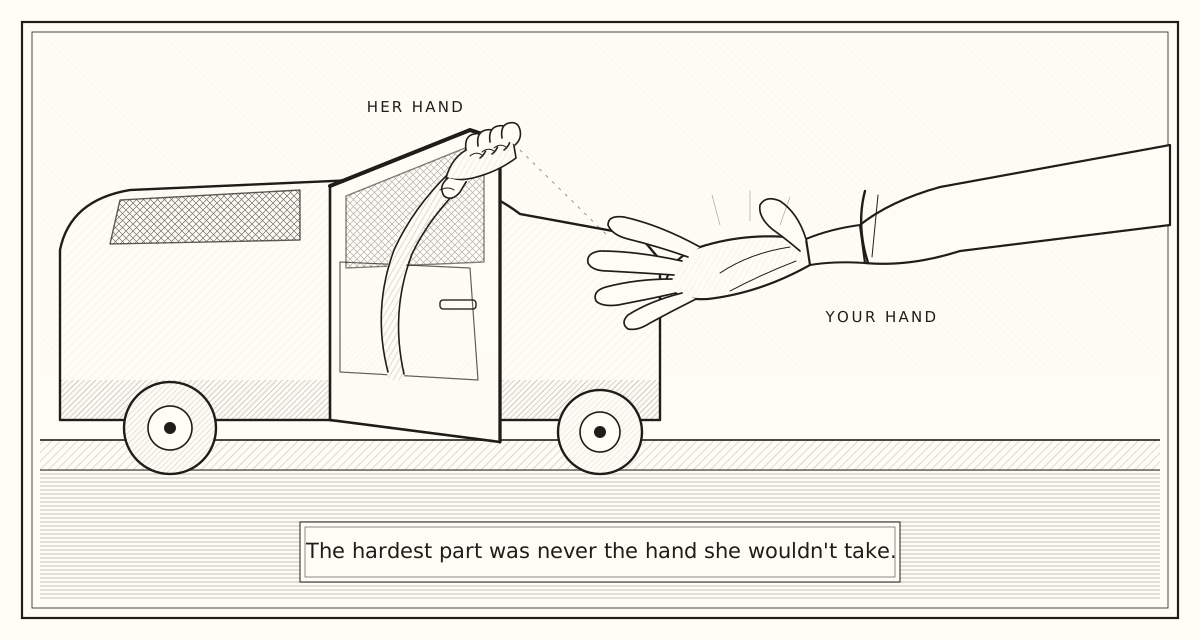
None of this is a trick. It is respect, worded so she can accept it. And it does not always work. Some days she will refuse the aide and the walker and the ride, and you will stand there with your hand out and nowhere to put it. That is all right. You are not trying to win. You are trying to stay close.
How to care for my elderly mother when I can't stand her right now
You do not have to feel warmly toward her to care for her well. That is the permission nobody gave me, so I am giving it to you.
Love, in a year like this, is not a feeling that shows up on schedule. It is showing up. It is the ride to the clinic on the morning you would rather be anywhere else. It is answering "Thursday" for the fourth time in a voice that does not carry the count. You can do those things while feeling nothing but tired, and they still count as love. Some days they are the only form of it available.
Here is what I did with the mornings I could not stand her. I shortened them. Forty minutes, one useful task, one thing she got to be right about, and out the door before I said something I would carry all day. A short visit I could repeat beat a long one that ended at the sink.
And I stopped letting the caregiving swallow her. When every visit is pills and rides and safety checks, you lose the actual person inside all the managing. So I carved out time to just be her kid again. I let her tell me the story about the winter the pipes froze, for the fortieth time, and asked a question as if I had never heard it. That is the part I am glad I kept.
How to deal with elderly mother with dementia: when the meanness has a cause
If your mother has dementia, or you suspect she does, some of what you are fighting is not her at all.
The repeated questions, the accusations that you took the checkbook, the sudden rage over a moved chair: these are the disease talking, and arguing with the disease is like arguing with weather. You will not win, and you will be soaked. The move is to stop correcting the facts and start answering the feeling. She does not need to be told, again, that the checkbook is in the drawer where it always is. She needs to hear that her money is safe and that you are on her side. The fact does not land. The reassurance sometimes does.
This is also the point where you stop being the only witness. A doctor's visit, with you in the room and a written list of what you have seen, is not a betrayal of her. It is the first time in a year that someone other than you has been asked to carry a piece of it. I put mine off for months. The answer, when it came, did not change what I had to do on Thursday mornings. But it changed how I read her, and how I read myself. She was not being mean to me. I was not failing her. We were both standing in weather neither of us had chosen.
What to say at the kitchen table
When she asks the same question again: "Thursday. And I'm glad you asked, because I almost forgot the appointment." Give her the answer and a reason the asking helped. It costs you nothing and it hands her something.
When she criticizes how you did it: "You're right, you always did that better. Show me." Half the time she can't, and she knows it, and the offer is the point. The other half, she can, and you learn something.
When she refuses the help: "Okay. I'll be right here if you change your mind." Then be right there. Close enough to catch her, far enough to let her try.
When you have been sharp: "I was short with you. That wasn't about you. I'm sorry." Then let it go. Do not make her comfort you for having lost your temper at her.
When you cannot do it today: "Mom, I'm going to head out early. I'll call you tonight." And then leave, before the sink. A visit that ends well at forty minutes is worth more than one that ends badly at two hours, and you are allowed to protect the ending.
What it cost when it went wrong
I did not apologize that Thursday. I told myself she would not remember, which was true, and that I would do better tomorrow, which was also true, and that neither of those made it all right, which I did not tell myself for about a month.
The cost was not the one sentence at the sink. The cost was what I did with it afterward. I decided I was a person who could not deal with my mother, and once you have decided that about yourself, you start proving it. I visited less. I called instead, and the calls got shorter. I let my sister take two weeks that should have been mine, and I called it giving her a chance to help. My mother, who could not remember what day it was, could absolutely tell that her son had gone somewhere, and she got quieter, and the quiet read to me as more negativity, and around we went.
What broke it was a photograph. My wife took it on a good evening, one of the first in a while with nothing owed to anyone, and handed me the phone, and I did what everyone does and zoomed in, and I did not recognize the man standing next to her. Heavier. Grayer. Hollows under the eyes I had been calling tired for so long I had stopped seeing them. I had spent a year reading my mother's face. Nobody had been reading mine, and the camera had been keeping a record I had not asked for.
That was the day I understood that "I can't deal with my mother" had never been a sentence about her. It was a sentence about a man with no one watching him, and it was the truest thing I had said all year, and I had been saying it at the wrong person.
So I put someone on the job. Not a therapist, not at first, though that came. A friend I had stopped calling back, who let me say the ugly true thing on a Tuesday night without trying to fix it. A walk after every visit, around the block, before I got in the car, so the visit ended on my feet instead of at a sink. Sleep, treated as the load-bearing thing it is instead of the first thing sacrificed. And one honest breath a day, five minutes in the car before I went in, where I was not managing anyone or bracing for anything. None of it fixed my mother. All of it fixed the morning.
The landing
The next Thursday may go the same way. She may ask four times, and you may feel the heat come up your neck on the third, and you may or may not catch it before the sink. That is all right. You are not trying to be a saint. You are trying to stay close to a woman who used to be the strongest person you knew, while she learns, slower than either of you would like, that letting you near is not the same as giving up.
You cannot deal with your elderly mother. That was always true. What you can do is deal with Thursday, and let her keep what she can still hold, and put one person back on the job of watching you. Catch your breath. The next hard thing will keep.
This is the idea at the center of two chapters of When the Keys Go, the first Tempered Press book, out now on Kindle. The second, Managing Mom's Money With Love, is out now on Amazon. One email when a book ships. Nothing between.
The books
- When the Keys GoA 2 a.m. guide to caring for your aging parents — and forgiving yourself. out now on Kindle.Buy on Amazon now
- Managing Mom's Money With LoveA field guide to your aging parents' affairs — and the institutions that keep saying no. out now on Amazon.Buy on Amazon now
One email when a book ships. Nothing between. Unsubscribe any time; never sold or shared.