My elderly parent is in a romance scam — how do I tell him, and what if he refuses to believe it?
Published by Corso & Alexander · About David Luria · Updated
The people and first-person scenes in this article are fictional/composite examples, created to illustrate the issues. They are not the author’s personal history. The scenes illustrate caregiving situations; they are not evidence of clinical or legal outcomes.
You cannot argue an elderly parent out of a romance scam, because a romance scam is not a belief he holds. It is a relationship he is in, and you are asking him to end it on your word against hers. So the first move is not the evidence. The first move is to stop the next dollar — the bank's fraud line, the money transfer app, the gift-card rack — without a single sentence about whether she is real. The second move is to stay the person he can still call, which means you never make him choose between you and her, because a lonely man who is made to choose will choose the voice that calls him every night. The proof comes later, and it works only if you find it together. Everything below is the order I learned it in, and most of it I learned by doing it wrong.
How to tell someone they are being romance scammed: the night I did it badly
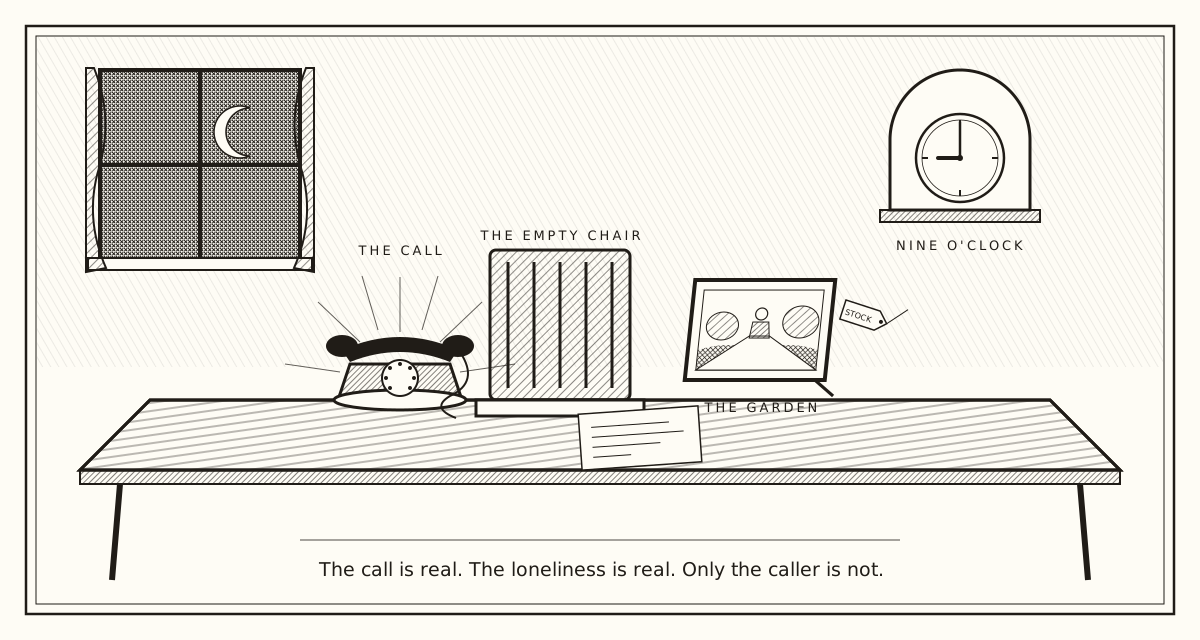
My father told me about her over dinner, the way you tell someone good news you have been saving. Her name was Marguerite. She was a widow, a nurse, working a contract in a country he could not quite pronounce, and they had been talking for four months. Talking every day. She sent him a photograph of herself in a garden. He showed it to me on his phone the way he used to show me pictures of my mother.
Edward was eighty-one. My mother had been gone for three years. I had been proud, honestly, of how he was managing — the meals, the pills, the crossword. I had not thought about what the evenings were like.
I knew what it was before he finished the sentence about the garden. And here is the first thing I did wrong: I let him see that I knew. My face did it before my mouth could. He watched me decide his happiness was a con, in real time, across a table, and something in him closed like a door.
Then I did the second thing wrong. I went and got the evidence. I did a reverse image search on the photograph that night, at my own kitchen table, an hour away, and found the same woman in a garden on a stock-photo site under a different name. I printed it. I drove it over the next morning like a subpoena. I laid the two pictures side by side on his kitchen table and said, Dad, look.
He looked. And then he said the sentence that every adult child in this situation eventually hears, in one form or another. He said, She told me people would say this.
Of course she had. That is the whole method. The scammer does not just build the relationship. She builds the defense of the relationship, in advance, so that the first person who tries to break it proves her right. I had walked into a script that had been written for me months earlier, and I had said my lines perfectly.
I was not wrong about the facts. I was wrong about everything else.
Romance scam red flags — the ones that matter when it is your father
Lists of red flags are everywhere, and they are accurate, and they will not help you at the table, because your parent has read the same lists. He has decided, specifically and with reasons, that they do not apply to her.
But you should know them, because they tell you what kind of thing you are dealing with, and that changes how you talk.
The Federal Trade Commission describes the shape plainly. Romance scammers create fake profiles on dating sites and apps, or reach out through ordinary social media, and then build the relationship through constant contact until there is trust. They have a reason they cannot meet in person: they are, in the FTC's words, "living or traveling outside the country, working on an oil rig, in the military, or working with an international organization." And then there is an emergency that money would fix — a medical bill, a plane ticket, a visa, a customs fee, an investment that cannot wait — and the money has to move in a way that cannot be pulled back: a wire, a gift card with the code read out over the phone, a transfer app, cryptocurrency.
Marguerite was a nurse on a contract abroad. Her son had been in an accident. The hospital would not release him without payment, and her own accounts were frozen because of the contract. My father had already sent money twice by the time he told me about the garden. He had not told me about the money.
Here is the red flag that is not on the lists. He did not tell me about the money. Not because he was ashamed of it, not yet, but because he had already been taught that I was the kind of person who would not understand. Isolation is not a side effect of the scam. It is the product. The money is what the scammer takes. The isolation is what she builds first, so that the money can be taken quietly, again and again, with nobody in the room but the two of them.
That is why the argument fails. You are not arguing with a mistaken belief. You are arguing with the one relationship in his life that is currently paying attention to him every single day, and you are arguing from the outside.
Why a romance scam victim refuses to believe it
I have thought about this more than almost anything since my mother died, and where I landed is not comfortable, so I will say it plainly.
My father was not stupid. He had run a department for thirty years. He could read a balance sheet and a person. What he could not do, at eighty-one, was be alone in the evenings after fifty-two years of not being alone in the evenings. And here was someone who asked him how his day was, every day, and waited for the answer.
The scam does not work on a fool. It works on grief. It finds the exact shape of the hole a marriage leaves and pours itself into it, and for a while — this is the part nobody wants to say — for a while it works. My father was happier that autumn than he had been in three years. He was sleeping. He was shaving. The scam was, in the narrowest and cruelest sense, good for him, right up until it was ruinous.
So when you lay the printout on the table, you are not showing him that a photograph is fake. You are showing him that the happiest thing that has happened to him since the funeral is fake. And the human mind does not accept that from a printout. It cannot afford to. Believing you would mean going back to the empty evenings and admitting he had been made a fool of and losing the money already sent, all in one afternoon, on the say-so of a child who, let us be honest, had not been calling every night.
That last part was the one that took me longest to hear. She called every night. I called on Sundays.
I am not telling you this to make you feel guilty. The scam would have found him whether I called or not; loneliness is their whole market. I am telling you so that you stop expecting the evidence to work. The evidence is true and it is beside the point. What he is refusing to believe is not that she is fake. It is that the loneliness is real and is going to come back.
How to stop an elderly parent's romance scam: the money first, the argument never
Here is what I did once I stopped doing it wrong. I am recounting, not advising; my father's bank is not your father's bank, and my father is not yours.
I stopped saying the word. After the printout, I did not say scam again for weeks. I said Marguerite. I asked how her son was doing. It felt like lying. It was not lying; it was staying in the room. The scammer's plan requires me to leave the room in disgust, and I had already done that once, and I was not going to do it twice.
I went to the money without going through him. This is the part that people skip because it feels like going behind his back, and I want to be honest that it is exactly that, and that I would do it again. I called the fraud line at his bank — not the main number, the fraud line — and said the sentence out loud: my father is sending money to someone he has never met, and I believe it is a romance scam. They had heard it before. They had a procedure. I could not move his money, and I did not want to; I had no authority on the account, and I was not going to borrow his login to get it. What I could do was ask them to flag it, and they did. The next wire he tried to send was held, and a person from the bank called him and asked him some questions, and he was furious, and it was not me he was furious at.
The bank has to say no sometimes so that you do not have to. I did not understand that until it happened. An institution can put a hand on a transfer in a way that a son cannot, and it can do it without ending the relationship, because the bank is not someone he loves.
I sat with him while he set the alerts. Not me, him. His phone, his account, his fingers. A text on any transfer over an amount he chose. A text on any new payee. He picked the number. I did not argue with the number. When you set the alerts yourself, on a parent's account, you have taken something; when he sets them, he has kept something. Either way the alert comes. Only one way leaves him the owner of his own money.
I asked to meet her. Not confront — meet. I said, I'd like to talk to her. Can we call her together on Sunday? And there was, as there always is, a reason we could not: the time difference, the contract, the hospital. I did not say see? I said okay, maybe next week. And the week after that. A relationship that can never be witnessed by anyone but the victim is the whole tell, and the victim is the one person who has to notice it. My job was to keep asking, gently, until the pattern was his observation and not my accusation.
I reported it, and told him I had. The FTC takes reports at ReportFraud.ftc.gov, and the FBI's Internet Crime Complaint Center takes them too, and the site or app where the contact began has a way to report a profile. None of that gets the money back, usually. I did it anyway, because a report is a thing that exists outside the two of them, and because when I told my father I had filed it, I said it as a fact about the world and not as a verdict on him. I reported the profile, Dad. If she's real, it costs her nothing. He did not speak to me for four days. Then he called.
How to tell someone they are being scammed without losing them
The conversation that finally worked was not about Marguerite at all.
It was a Sunday, and I asked him what the evenings were like. Just that. Not are you lonely — nobody answers that — but what do you do after dinner. And he told me. The television, mostly. The crossword until his eyes gave out. And then the phone would light up, around nine, and it would be her.
I said the hardest true thing I have ever said to my father. I said: I think you deserve someone who asks how your day was. I don't think she's the one who gets to be that person, and I'm sorry that I wasn't.
He did not agree with me. He did not have to. What happened instead was that the choice stopped being me or her and became the evenings, and what to do about them, and that was a problem we could work on side by side instead of across a table.
That is the conversation I would offer you, without a promise, because I had it once and do not know that it works twice. Do not tell him she is fake. Tell him what you see: that he is happier, and that you are glad, and that you are also frightened, and that you would like to be frightened together instead of separately. Ask to meet her. Ask again. Let the bank be the villain. And say the thing about the evenings out loud, because the evenings are where the whole thing lives.
If he has been told that you would say all this — and he has — then the only thing that breaks the script is that you keep coming back after saying it. The scammer's model of you is a person who shouts once and leaves. Be someone else.
What it cost when it went wrong
The money my father sent before I knew is gone. I am not going to write the number, because it is his, but I will tell you that it was not the whole of what he had, and that the bank's hold on the third wire is the reason it was not more.
Four days of silence, after the report. Roughly three months, all told, from the garden photograph to the evening he said, without looking at me, I don't think she's coming. He did not say scam. He has never said it. He said I don't think she's coming, and I said no, I don't think so either, and we sat with that, and it was grief, plain grief, the same kind as the other kind.
What it cost me was the printout. Literally — the morning I drove it over set us back by weeks — and as a way of thinking. I had believed that the truth, laid flat on a table, does its own work. It does not. Not with money, not with love, and not with a parent who has already been told exactly what you are going to say.
And what it cost, underneath, was the thing I have to live with: that the loneliness had been there for three years and I had not seen it, and someone in another country had seen it in a week. That is not a thing to fix. It is a thing to know, and to let change how often the phone rings on a Tuesday.
Where the rest of this lives
The practical doors — the credit freeze, the alerts, the spoken passcode on the phone account, the email with a second step — are the same ones from the afternoon in what to do if your elderly parent is being scammed, and they close the same way. A romance scam walks through most of them eventually, once the scammer has enough to open something in his name, so shut them. But shut them with him, narrating each one, so that the afternoon is a thing you did together and not a thing that was done to him.
And if the evenings are the real problem — they were, for us — then the grief underneath has a name, and it is not foolishness. It is ambiguous loss, the kind where someone is gone and the place they held is still furnished. My father was not in love with a photograph. He was in love with not being alone at nine o'clock. That is not a red flag. That is a man.
The landing
It is January now. There is no Marguerite. There is a woman at his church named Ruth who has also lost a husband, and they do the crossword on the phone at nine, and she is, as far as I can tell after two lunches and a Christmas, entirely real. I did not arrange it. I am not sure I could have.
The alerts are still on. He set them. The bank still has the note on the file. He is the one who told them to keep it.
Last month he asked me how my day was, and waited for the answer.
- Federal Trade Commission: What To Know About Romance Scams
- Report fraud to the FTC
- FBI Internet Crime Complaint Center
Source links checked September 24, 2026. General information, not legal or financial advice; what a bank can hold or flag, and on whose say-so, varies by institution and by what authority you hold on the account.
This draws on the thinking behind Managing Mom's Money With Love, the Tempered Press field guide to your aging parents' finances, out now on Amazon, and on the heart of When the Keys Go, the 2 a.m. guide to caring for an aging parent. One email when a book ships. Nothing between.
The books
- When the Keys GoA 2 a.m. guide to caring for your aging parents — and forgiving yourself. out now on Kindle.Buy on Amazon now
- Managing Mom's Money With LoveA field guide to your aging parents' affairs — and the institutions that keep saying no. out now on Amazon.Buy on Amazon now
One email when a book ships. Nothing between. Unsubscribe any time; never sold or shared.