My elderly parent keeps leaving the stove on — is it dementia, and what do I do?
Published by Corso & Alexander · About David Luria · Updated
The people and first-person scenes in this article are fictional/composite examples, created to illustrate the issues. They are not the author’s personal history. The scenes illustrate caregiving situations; they are not evidence of clinical or legal outcomes.
An elderly parent leaving the stove on needs a safety response, even before the cause is known. Repeated incidents do not establish a dementia diagnosis; discuss the changes with their clinician. The Alzheimer’s Association recommends kitchen safety measures, including suitable automatic shut-off appliances and preventing unsafe stove use. Choose measures for the person and appliance, not a generic shopping list. Cooking may need supervision or a safer alternative. No gadget makes an unsafe situation safe on its own.
Here is the afternoon I learned that, and the thing I got wrong before I learned it.
My mom keeps forgetting to turn off the stove: the afternoon it started
I smelled it before I was through the door.
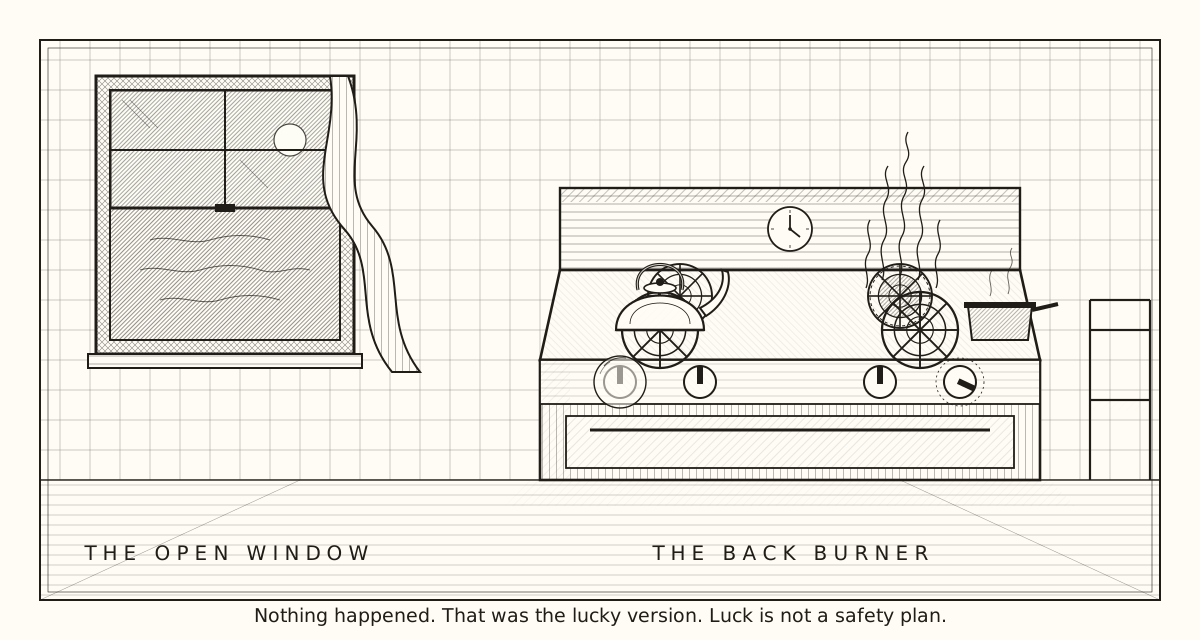
Not smoke. Something worse in its way — scorched metal, a pot boiled dry and left to burn. My mother, Sophia, was in the living room with the television up loud, unaware. She had put water on an hour before and forgotten it. The kettle was fine. It was the back burner, the empty one she had turned on by mistake, that had been running the whole time with nothing on it but heat.
Nothing happened. That is the part that stayed with me afterward. Nothing happened — no fire, no ambulance, a ruined pot at worst. But standing in that kitchen with the window thrown open and the smell in everything, I understood that "nothing happened" was the lucky version. Luck is not a safety plan. And I understood something else, though I did not have words for it yet: the woman who taught me to cook had just, quietly, become someone I would have to watch in her own kitchen.
If you are here, maybe you have smelled it too. Or found the scorch mark on the counter no one mentioned, the pan of eggs gone hard and forgotten, the smoke alarm chirping at three in the morning because it had earned the right. Maybe your father still cooks fine, and you are reading this because one bad afternoon put a question in your head that will not leave.
The question is usually the one in the title. Is this dementia? Let me answer it as honestly as I can.
Is leaving the stove on a sign of dementia?
Sometimes. Not always. And you cannot tell from the pot.
I say that plainly because the first thing I did after the burned-pot afternoon was type that exact question into my phone at eleven at night, and what came back was a wall of checklists, each written as if a forgotten burner were a lab result. It is not. Everybody has left a stove on. Distraction does it. A phone call does it. Grief does it — I have watched my mother forget things she had never forgotten in the weeks after a funeral, and it was not her brain, it was her heart.
What I have learned to trust is not the single event but the shape of the events over time. One forgotten burner is a story you tell at dinner. Three in a month, plus the eggs, plus the alarm she unplugged, plus the same safe meal on repeat because the recipes have gotten hard — that is a pattern. And a pattern is not a diagnosis either. It is a reason to go to the doctor with something more useful than worry: a short list of what happened and when.
That is all I will say about the medical question, because I am not a doctor and this is not a medical page. What I can tell you is that you do not have to wait for the doctor to make the kitchen safe. The stove does not care what the cause is. It burns the same either way.
There is a harder question underneath, and nobody's checklist asks it.
What an elderly parent leaving the stove on is really about
It looks like a conversation about safety. It is not, not really. It is a conversation about who takes care of whom.
For your parent, that stove was where they fed you. Not just food — care, made visible, three times a day for decades. The pot of soup when you were sick. The big meal that pulled everyone home for the holidays. The plate pushed toward you before you had even sat down. For a lot of parents, cooking was how they said I love you without having to say it. It was proof they still had something to give.
My mother came to this country with two recipes and a pot, and fed a family on them for fifty years. When people came to her house, they ate. That was who she was. To think about taking the stove away was to think about taking the last room in the house where she was still entirely herself.
And you are at that table too. You are grieving — not only for them, but for yourself.
You are grieving being fed. For your whole life, walking into that kitchen meant someone was glad you came and had something ready. Now you are the one bringing the food, or watching the burners, or quietly counting how many days the leftovers have not moved. That is a loss with no name and no ceremony, and it can ache even when the smoke alarm never goes off. If you have read the note here about ambiguous loss, you already know the word for a grief that has no funeral. This is one of its rooms. The person is here, humming in the living room. The cook is going.
Hold on to this, because you will need it in the next section: you did not take the stove. Age did. You are just the one who happened to be standing in the kitchen, so it feels like your hand turned it off. It did not.
I needed that sentence badly, because of what I did next.
How to take the knobs off the stove — and why I did it wrong
The internet will tell you, correctly, that the knobs on most ranges pull straight off. It took me about forty seconds. I did it on a Tuesday while my mother was at the hairdresser, and I put the four knobs in a zip bag in the glove compartment of my car, and I drove home feeling like a man who had solved something.
I had not told her. That is the part I want you to hear. I had decided, alone, in her kitchen, that the safest thing was for her not to be able to cook, and I had made that true without a word, and I called it protecting her.
She called at six. Not angry. Confused, at first, the way you are when a thing you have done ten thousand times stops working. Then she understood, and her voice changed, and what she said was: "You could have asked me."
She was right. I sat in my kitchen with the phone in my hand and could not answer. I had treated a fifty-year cook like a child who had reached for the stove. I had walked into the one room where she was still fully competent — where she still knew how much salt by the weight of it in her palm — and taken it away from her while she was out getting her hair done. I had made the kitchen smaller before I had tried to make it safer. And I had done it behind her back, which told her more about how I saw her than any burned pot had told me about her.
I drove back that night and put the knobs on. We sat at the table. And that was when the real conversation started, the one I should have had first.
So if you take one thing from the story: do it with them, not to them. The tools below are good tools, and every one is a different thing depending on whether your parent knows it is there. Installed together, a kindness. Installed in secret, a verdict.
Dementia stove safety: make it safer before you make it smaller
This is the step people skip on their way to ripping the stove out, and it is the step that matters most, because a kitchen made safer is a very different thing from a kitchen taken away.
Start with the tools that let them keep cooking. Knob covers are clear plastic caps that snap over each burner knob, so a passing hip cannot turn a burner on and a curious grandchild cannot either. They cost about what a sandwich costs and take two minutes to put on, no tools. They do not stop a person who wants to cook from cooking; they stop the accidental turn. That distinction is the whole point. An auto-shutoff device sits on or near the range and cuts the power if a burner runs unattended too long. It is the single change I wish I had made first, because it takes the safety off anyone's memory — hers or mine — and puts it on the appliance, where it belongs. A different appliance may help, but do not assume it removes the risk. Check the controls, shut-off features and installation instructions for the actual model. A hot pan can still burn someone. Ask a qualified installer and the person’s care team what is suitable before changing the setup.
Then the thing you do not want to be wrong about. A working smoke alarm with a sealed ten-year battery, one in the kitchen and one in the hall outside the bedroom. If theirs is chirping, or unplugged, or older than the dog, this is the item you replace tonight. It is the floor under everything else.
None of these is the answer. Every one is a head start — so that when the harder conversation comes, you are not also standing in a kitchen with nothing in it.
And one more, which I learned the hard way. Whatever you install, install it at the table, together, with the box open and your parent holding the instructions. Involve them in the choice; have the device installed as its manufacturer requires. Let them try the knob covers on and off. The tools are cheap. The dignity is not.
Home safety checklist for dementia patients: the quieter question
Every checklist you find will be about the fire. The fire is the loud danger. There is a quiet one, and it is often the bigger one, and it was on none of the pages I read at eleven at night.
Are they eating?
If cooking has gotten hard, the meals get smaller and worse long before anything ever burns. The fridge tells you. Spoiled food. The same safe meal on endless repeat. Food that was bought and never opened. A freezer with three things in it. I did not look in my mother's refrigerator until weeks after the burned pot, and when I did, it was a museum — jars from a life that used to have people in it, and almost nothing that was food today.
So the checklist I would give you starts in the fridge, not at the stove. A week of prepared meals in the freezer, from the grocery store's ready-made section or a delivery service — real food that needs a microwave and a plate. A standing grocery order, so the staples arrive whether or not anyone remembers to shop. A shared grocery list on their phone, which is free and sounds small: you add what you notice they are out of, they add what they want, and the fridge stops emptying without anyone noticing. And more dinners together — the one item on the list that solves the safety problem and the loneliness problem in the same hour.
The safest fix for a stove is sometimes making sure that good food is within reach without a stove at all. That is not giving up on the kitchen. It is making sure the kitchen is not the only way they get fed.
What to say at the stove
Here is the conversation I should have had on the Tuesday, and did have on the Tuesday night, with the knobs back on and the table between us.
She will not hear "safety." I want you to know that going in, because I led with it and watched it land like an insult. What she hears, when you say the word safety, is that the thing she is best at — the way she has taken care of all of you — is being taken from her. So do not lead with the burner. Lead with the cooking.
What I finally said, badly, was something like: "Mom, nobody feeds this family like you do, and I am not trying to end that. I want to keep you cooking as long as we can do it safely. That is why I should have figured this out with you instead of around you." The last sentence was the one that mattered. It was an apology, and she needed the apology before she could hear anything else.
Then one real thing. Not a list — a list is five things she can argue with. One moment she can picture. "The pot on the back burner last week really scared me." She did not argue with that. She had smelled it too. She had just not wanted me to know.
She said what every parent says: that she had been cooking since before I was born. She had. I did not fight it. I said, "You have. That is exactly why I don't want one bad afternoon to be how it ends." And she let me in.
And then — this is the part I would have skipped a year ago — give them a way to stay in the kitchen, not just a way out of it. We agreed on the shutoff device, and she chose where it went. We agreed I would come on Sundays and she would cook and I would handle the heat. Being pushed out of your own kitchen is its own kind of grief, so do not push — invite. Let them stir the pot, snap the beans, tell you how much salt, own the one dish they have made a thousand times while you stand at the stove. Cooking together keeps them useful and keeps you close, which turns out to be its own kind of safety.
If you cannot find the words, it is fine to borrow some. Describe your real parent and your real kitchen to whatever helper you use, and ask it to help you say the thing without making her feel pushed out. It will not know your mother. But it will hand you a place to begin.
The landing
We still cook on Sundays. She runs the recipe and I run the heat, and the shutoff device sits behind the range where she decided it should go, and the knob covers have yellowed and I have replaced them twice. Twice more there has been a smell when I came through the door, and twice the device had already done its job. Nothing happened. Which is still the lucky version — but now the luck has help.
None of this fills the quiet where the smell of her cooking used to be, and I will not pretend it does. The stove is a small room in a larger loss, and the larger loss does not close because you bought a knob cover. What changes is not the loss. What changes is that you stop reading it as a verdict on yourself — and, if you can manage it better than I did, you stop delivering one to her.
If you are standing in a kitchen tonight with the window open, here is what I have. Trust the pattern, not the one good dinner. Take the pattern to the doctor and leave the diagnosis to them. Make the kitchen safer before you make it smaller, and make it together. Look in the fridge. Keep them involved in safe parts of preparing a meal, with supervision suited to their needs.
And know this. You did not take her kitchen tonight — you found a way to keep her in it a while longer. That was a loving thing, and you did it. Catch your breath. The next hard thing will keep.
If you want the wider frame — why a change like this feels like grief when nobody has died, and what to do with that — the note on ambiguous loss is where I would go next. And the front page says what this small house is trying to do, one book at a time.
Sources and further help
- Alzheimer’s Association: home safety guidance
- Alzheimer’s Association: assessing symptoms and seeking help
Source links checked September 20, 2026. This article offers general information; the linked authorities explain the rules and guidance in more detail.
This is the idea at the center of one chapter of When the Keys Go, the first Tempered Press book, now at the typesetter. One email when a book ships. Nothing between.
The books
- When the Keys GoA 2 a.m. guide to caring for your aging parents — and forgiving yourself. out now on Kindle.Buy on Amazon now
One email when a book ships. Nothing between. Unsubscribe any time; never sold or shared.